
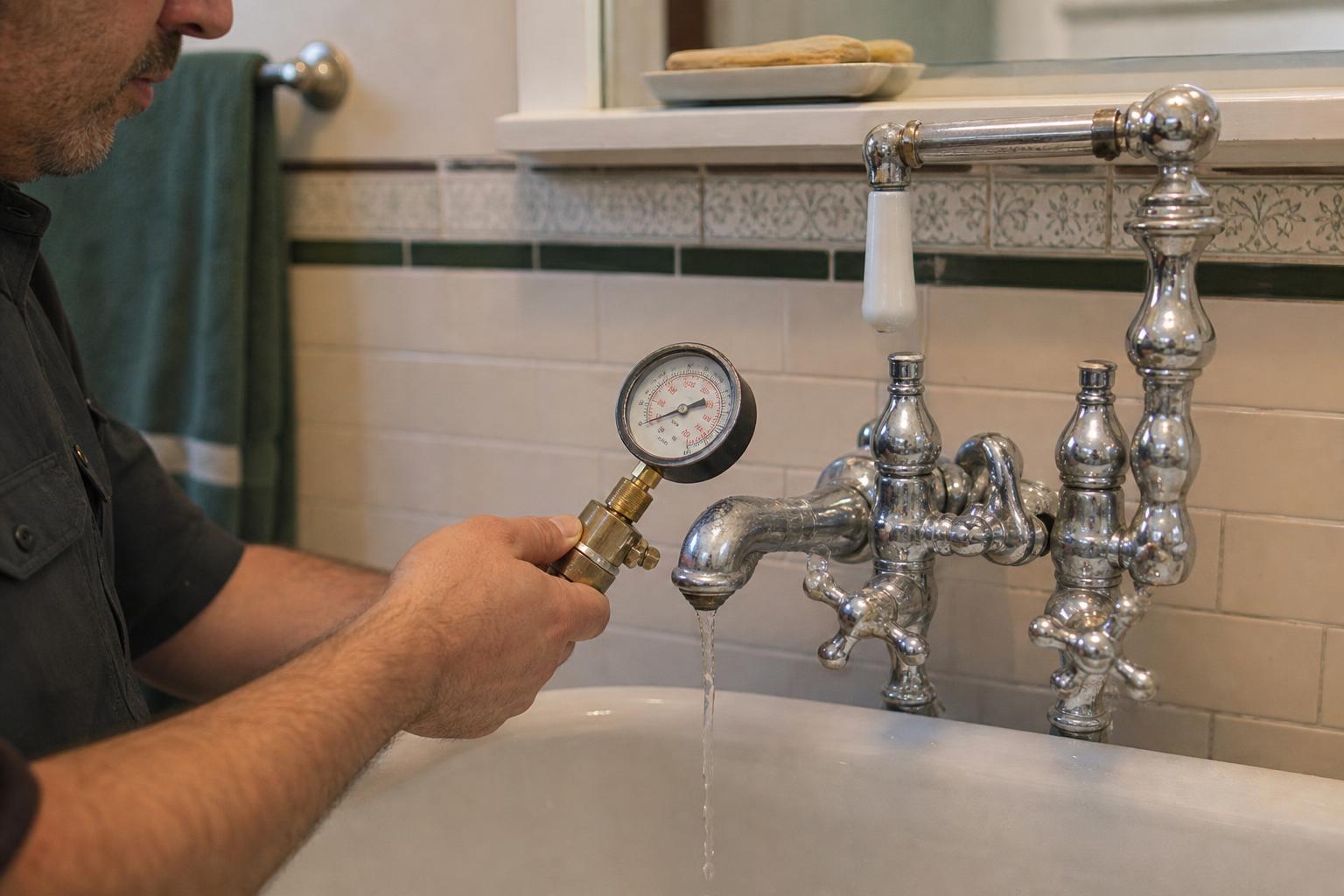
Low hot water pressure in an old Seattle house has more than one possible cause, and it is not always a full-house emergency. Sometimes it’s a valve that never got fully reopened after a repair. Sometimes it’s a water heater choking on sediment. Sometimes it really is galvanized pipe closing up from the inside, and a repipe is the only fix that lasts. The problem is when a repipe quote shows up before anyone rules out the cheap fixes. We check the easy stuff first, every time, and tell you plainly which situation you’re actually in.
- Most common causeGalvanized supply lines scaling shut, usually worse on the hot side than cold
- Rule out firstShutoff valves, the pressure-reducing valve, water heater sediment, clogged aerators
- Quick tellWeak hot water at every fixture, not just one, is the pattern that points to the pipe
- If it is the pipeTargeted section replacement or a full repipe, priced Good / Better / Best before any work starts
Why hot water pressure fades first in an old house
A homeowner on r/askaplumber described almost exactly this problem: weak hot water pressure, a quote around $11,000, and one honest question underneath it: are there situations where a full repipe is truly the only solution, or are there other things that should be ruled out first? That question deserves a real answer, because “my hot water pressure is weak” and “I need a full repipe” are not automatically the same statement. One is what you’re standing in the shower feeling. The other is a diagnosis.
Hot water accelerates corrosion inside galvanized steel pipe. The zinc coating that protects the steel wears through faster on the hot side, so the rust and mineral scale that narrow the pipe’s inside diameter build up there first. A house can run reasonable cold pressure for years while the hot side quietly sputters, because the two are different pipes with different histories inside the same walls. That’s also why a plumber who checks pressure at one fixture, or who jumps straight to a repipe recommendation without testing the water heater and the valves first, can miss what’s actually going on.
Homeowners in online forums report repipe quotes anywhere from roughly $6,000 to over $20,000 depending on the house, and the $11,000 figure above sits on the lower end of that range for a hot-side complaint. If a technician’s answer to weak pressure is a tablet full of upsell options and a same-visit “discount,” that’s worth a second look. A sanity check belongs before a five-figure number, not after it.
What we rule out before anyone mentions a repipe
Check the shutoffs
A valve under a sink, at the water heater, or at the main that isn’t fully open can throttle flow enough to feel like a pipe problem. We open and test every accessible shutoff first.
Test the pressure-reducing valve
A failing PRV usually drops pressure house-wide, but a stuck one can read worse on hot depending on how the branches are plumbed. We gauge it at the meter and a few fixtures.
Open up the water heater
Sediment in the tank and a clogged or broken dip tube are two of the most common reasons hot pressure drops while cold stays normal. Both are fixable without touching a supply line.
Clean or replace aerators and cartridges
A clogged aerator or worn cartridge can starve one fixture while the rest of the house is fine. If it’s really just one sink or shower, this is often the entire fix.
Isolate the actual run
We test pressure at several fixtures, hot and cold, upstairs and down, to see whether the loss is local to one branch or spread across the house.
Most of these checks happen on the same visit, and several of them are the whole fix. Curious what a visit like this looks like end to end? See how our free quote works.
When the pressure loss really is the pipe
If pressure is weak at every hot fixture, worse the farther the water travels, and paired with rust-tinted water on the first draw or a pinhole leak that’s already shown up elsewhere, that’s a pattern a cleaned aerator or a new PRV won’t fix. The line itself has scaled down from the inside, and scale only gets tighter with time. In that case we tell you honestly, and the conversation moves to a targeted section replacement or a full repipe depending on how much of the system is affected. See how we handle old-home repiping, or start with how to tell if you have galvanized pipes if you’re not sure what’s behind your walls yet.
Quick fix or the pipe? A rough read
| Pattern | Likely a quick fix | Likely the pipe |
|---|---|---|
| Where it’s weak | One fixture | Every hot fixture |
| Pressure at the water heater outlet | Normal | Already dropping |
| Water color on first draw | Clear | Rust-tinted |
| Cold-side pressure | Also weak (often the PRV or main) | Normal, only hot is weak |
| Supply lines | Newer, or recently touched by a remodel | Original galvanized, house built before roughly 1960 |
Pressure readings at the meter, the water heater, and two or three fixtures, plus photos of the valves, the PRV, and whatever we find when we open the water heater’s access panel.
Whatever we actually did, whether that’s a cleared aerator, a serviced PRV, a flushed water heater, or the start of a repipe conversation, shown with the readings that prove pressure is restored or the scope of what’s ahead.
Not sure which one you’re dealing with? Let’s find out.
We’ll test pressure at the source before we talk about anything else, including whether a repipe is even the right conversation.
Related reading
Old-home repiping
What we replace, how the Good / Better / Best tiers work, and how a repipe day actually goes.
How to tell if you have galvanized pipes
The signs to check yourself before you ever need to call anyone.
Water heater installation and efficiency upgrades
If the sediment or dip tube turns out to be the real story, here’s how we handle it.
Questions homeowners ask about hot water pressure
Why is only my hot water weak, not my cold water?
Hot water speeds up corrosion inside galvanized pipe, so the scale that narrows the interior builds up faster on the hot side. A water heater with sediment buildup or a clogged dip tube can also restrict hot flow while the cold line, which bypasses the tank, stays unaffected. We check both before assuming either one.
Can a water heater really cause low pressure on its own?
Yes. Sediment settles at the bottom of the tank over years and can partially block the outlet, and a broken dip tube disrupts flow before water even leaves the tank. Both are common in older homes, both are fixable without opening a wall, and both are on our checklist before a repipe is ever discussed.
What if the pressure-reducing valve is the problem?
A failing PRV typically lowers pressure across the whole house, though the exact pattern depends on how your branches are plumbed. We gauge it at the meter and compare readings at a few fixtures. Replacing a PRV is a straightforward, contained repair, nothing close to the scope of a repipe.
How do I know if it’s really the galvanized pipe?
The pattern that points to the pipe is pressure that’s weak at every hot fixture, worse the farther water travels, often paired with rust-tinted water on the first draw of the day. One weak fixture, normal pressure at the water heater outlet, or clear water all suggest something smaller and cheaper. We test rather than guess either way.
If I do need a repipe, does the whole house have to be redone?
Not always. Sometimes one failing branch is the whole problem and a targeted section replacement solves it. Sometimes the entire system is equally scaled and a partial fix would just move the next failure somewhere else. We show you what we found and lay out Good, Better, and Best options so you’re choosing with real information, not a guess.