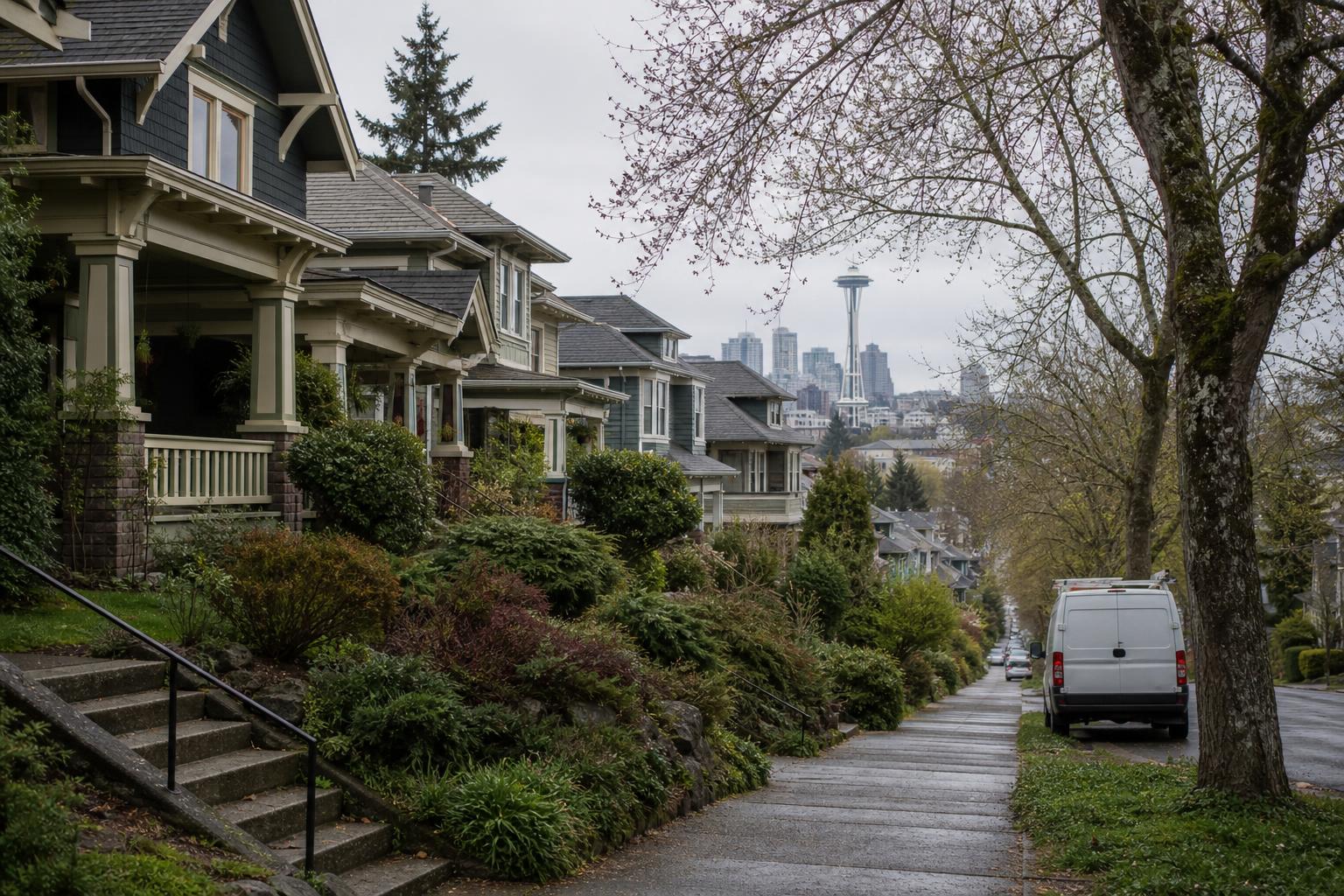
Nic’s Plumbing works in eight Seattle neighborhoods, from the hilltop Victorians of Queen Anne to the condo towers of Belltown. Most of that map is old housing, and old housing is what we are built for: galvanized supply lines, cast-iron stacks, clay side sewers and lath-and-plaster walls. Find your neighborhood below and see what we typically run into there.
- Where we workQueen Anne, Magnolia, Fremont, Ballard, Wallingford, South Lake Union, Belltown and Downtown Seattle
- What we see mostOriginal supply lines, side sewers and water heaters in homes built before the 1960s
- Combined-sewer basinsBallard, Fremont, Wallingford and north Queen Anne drain sewage and stormwater in one pipe
- Same standard everywhereThree priced options approved before work, floor runners, live tracking, photo proof
The eight neighborhoods, and what their houses tend to hide
Each neighborhood has its own page covering housing eras, landmarks and the plumbing problems that repeat there. Here is the short version.
Queen Anne
ZIP 98109, 98119. Victorians, foursquares and craftsman homes climbing the hill, many from the early 1900s. Three floors of fixtures on a century-old supply system is the classic Queen Anne pressure complaint.
Magnolia
ZIP 98199. 1920s and 1930s craftsman and Tudor homes near the Village, mid-century houses toward Discovery Park. Long supply runs, finished basements and original tile are what we plan around.
Fremont
ZIP 98103. Early cottages and craftsman bungalows on the slopes above the Ship Canal, newer townhomes between them. Galvanized still feeds many Fremont kitchens, and the neighborhood sits in a combined-sewer basin.
Ballard
ZIP 98107, 98117. 1910s and 1920s bungalows near the core, brick and mid-century homes farther north, decades of partial updates joined under the floor. Tight crawlspaces and a combined sewer make Ballard a specialist’s neighborhood.
Wallingford
ZIP 98103. Craftsman bungalows and box houses from the 1910s and 1920s on flat, walkable blocks. Original cast-iron stacks, clay side sewers and combined-sewer drainage come up in most conversations.
South Lake Union
ZIP 98109. Mostly newer mid-rise condos and apartments, with a few older brick buildings left from its industrial days. Work here is usually in-unit fixtures and water heaters, coordinated with building management.
Belltown
ZIP 98121. High-rise condos, converted older brick buildings and everything in between. Unit-level repairs, water heater swaps in tight closets and leak tracing between floors are the common calls.
Downtown Seattle
ZIP 98101, 98104. Condos, lofts in historic buildings and street-level small businesses. In-unit plumbing, fixture repair and water heaters, with the same photo documentation a house gets.
Why our map is built around old houses
If you own a house in Queen Anne, Magnolia, Fremont, Ballard or Wallingford, there is a good chance nobody has replaced its supply lines since it was built. Galvanized steel and cast iron last a long time, and when they fail they do it quietly: brown water when the hot tap first opens, a shower that fades when the toilet flushes, a slow drain that keeps coming back, a damp basement wall after a hard rain. Homeowners tell us they lived with those symptoms for years because every plumber patched one spot and left.
We chose these neighborhoods on purpose. The housing is old enough that the plumbing needs a specialist, and the homes are worth keeping, so the fir floors, plaster walls and original tile matter as much as the pipe. Every job on this map runs the same way: we look first, write up Good, Better and Best options with real prices, you approve one before we start, we protect the house while we work, and you get before-and-after photos when we leave. Read the full Nic’s Plumbing process for the details.
- Floor runners and shoe covers on every job
- Good / Better / Best quote approved before work
- Live map of your technician en route
- Before-and-after photos of every repair
- Permanent fixes recommended over patches
What a house’s age tells us before we open a wall
The year a house was built is the first clue to what is inside it. Remodels change the picture and we never assume until we have looked, but this is roughly what we expect across the map.
| Typical era | Where you see it | What we often find | Most common work |
|---|---|---|---|
| 1890s–1920s | Queen Anne, Wallingford, Fremont, Ballard core | Galvanized supply, cast-iron stacks, clay side sewers, tight chases in balloon framing | Whole-house repiping, side sewer repair |
| 1920s–1940s | Magnolia, north Ballard, Wallingford | Galvanized meeting later copper, original drains, basements that take on water in heavy rain | Partial repipe, storm drainage |
| 1950s–1970s | Magnolia, north Ballard, upper Queen Anne | Copper supply, aging water heaters, cast iron nearing the end of its life | Water heaters, drain and fixture work |
| 2000s and newer | South Lake Union, Belltown, Downtown, townhomes citywide | Modern materials, in-unit water heaters, fixture wear, shared-building rules | Service calls and fixture repair |
Old-house note: the combined-sewer neighborhoods
Seattle Public Utilities notes that sewage and stormwater from Ballard, Fremont, Wallingford and the northern portion of Queen Anne flow into the same combined sewer system. For a homeowner that means a heavy-rain problem and a sewer problem can look identical from the basement, and the side sewer connecting your house to that system is yours to maintain. If you live in one of those four areas, start with our Seattle side sewer guide or the basement flooding guide, and we will tell you which problem you actually have before quoting either one.
The four repiping neighborhoods
Whole-house repiping is our flagship service, and most of it happens where pre-1950 housing is densest. These four pages cover what a repipe looks like in that neighborhood’s homes: wall construction, routing choices, the finishes we protect, and how the Good, Better and Best options usually shake out.
Wallingford, South Lake Union, Belltown and Downtown homes get the same repipe service; start from the main old-home repiping page. For everything else, see sewer line repair, water heaters, storm drainage and service calls, all available across the map.
In one of these neighborhoods? Let us take a look.
Tell us the neighborhood and the symptom. We will diagnose it, explain it plainly, and send Good, Better and Best options to approve before any work starts.
Questions about where we work
My neighborhood is not on the list. Can you still help?
Our map is the eight neighborhoods above, chosen so we can give old houses the time they need. If you are close to one of them, call (206) 571-6044 and ask. If the job is a good fit we will say so, and if it is not we will say that too.
Do you work on condos and apartments, or only houses?
Both. South Lake Union, Belltown and Downtown are mostly condo and apartment work: in-unit fixtures, water heaters in tight closets, leaks between floors. We coordinate with building management where required, and the process is the same as in a house: written options approved first, protected work area, photos when we are done.
How do I know whether my house still has its original pipes?
Look at the exposed pipe near the water heater or where the main enters the basement. Gray, threaded pipe that a magnet sticks to is galvanized steel; copper is reddish; PEX is colored plastic. Brown water when the hot tap first opens is a strong hint too. Our guide to telling if you have galvanized pipes walks through it.
Does the neighborhood change the price?
Not directly. What moves the price is the house: size, fixture count, how the walls and floors are built, access, and the materials you choose. Neighborhoods matter only because they tend to share a housing era, so a Wallingford bungalow and a Queen Anne foursquare start from different places. Either way you see three written prices before deciding.