
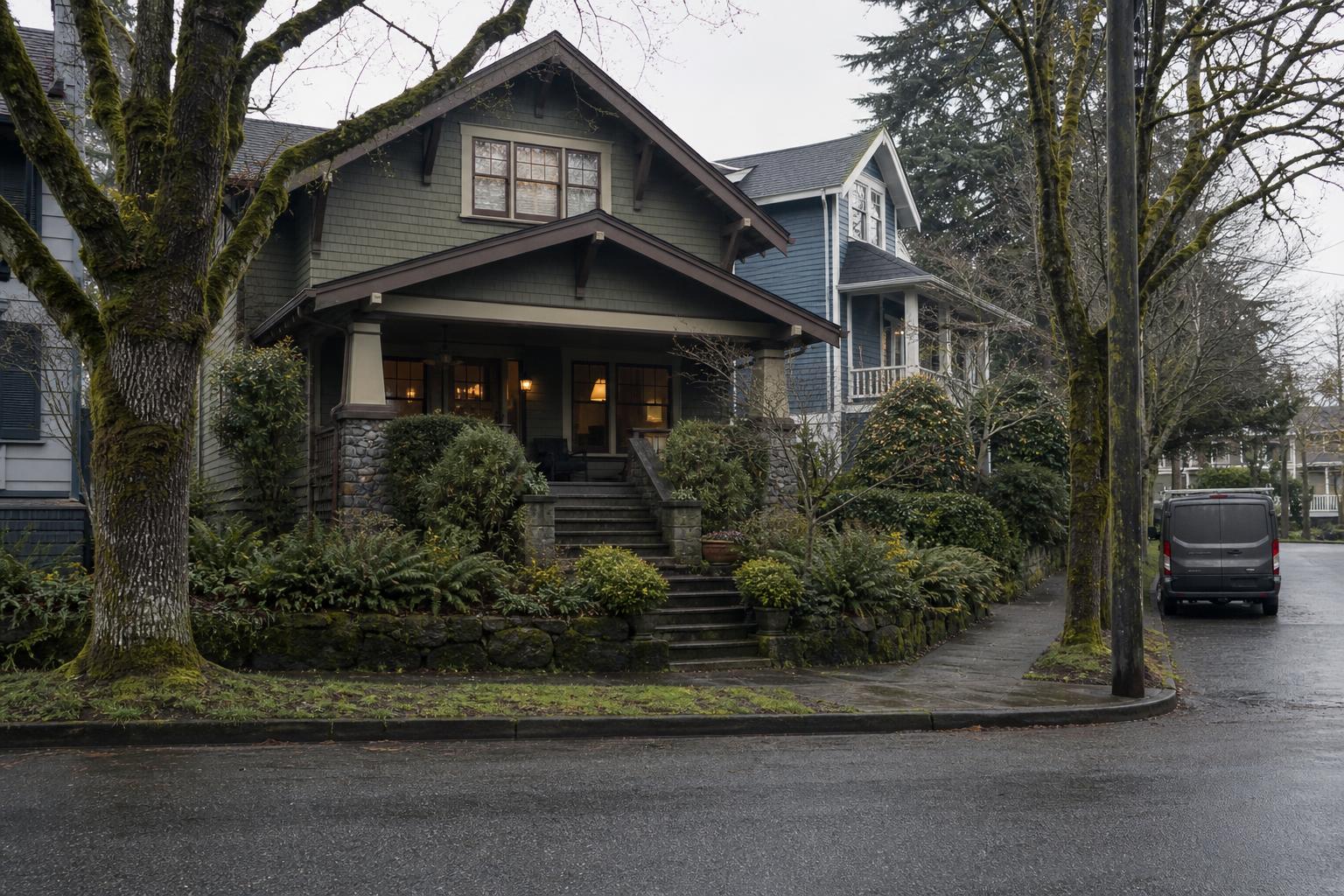
Wallingford climbs the hill north of Lake Union in rows of 1910s and 1920s craftsman bungalows and Seattle box homes, built so close together in date and style that the whole neighborhood tends to hit the same plumbing milestones at once. It runs from the N 45th St corridor to the quieter blocks near Meridian Park. A house’s age and where it sits on that slope both change what the pipe in the wall is doing.
- ZIP code98103, N 45th St corridor up past N 50th toward Green Lake
- Housing eraMostly 1910s–1920s craftsman bungalows and Seattle box homes
- Local landmarksN 45th St corridor, Meridian Park, Good Shepherd Center, Gas Works Park
- Sewer systemCombined sewer neighborhood, per Seattle Public Utilities
The ridge-to-lake slope is Wallingford’s real variable
Wallingford runs downhill from the ridge near N 50th toward Lake Union and Gas Works Park, and where a house sits on that fall changes two things. Houses lower on the hill tend to have older, shallower basements, so the lowest drain sits closer to the level of the street main than it does up on the ridge. And the side sewer from a lower-slope house often travels farther, at a flatter pitch, to reach that main — and a flatter run carries solids more slowly, giving roots and settled joints in old clay more chance to catch something. The same storm that barely registers on Densmore up top can put water in a floor drain three blocks downhill.
Above ground the housing is unusually uniform. The bungalows on Densmore, Bagley, Sunnyside and the numbered avenues near Interlake went up mostly in the 1910s and 1920s, when galvanized steel was the standard, on a flat grid of similar lots. Many have been remodeled since, which often means galvanized feeding copper feeding newer plastic. Uniform housing has one advantage: what a neighbor’s house turned out to have is a genuinely useful clue about yours.
Old-house note: Wallingford’s combined sewer system
Seattle Public Utilities has said sewage and stormwater from Wallingford, Fremont, Ballard and northern Queen Anne flow into the same combined sewer system. A heavy atmospheric river and a failing side sewer look identical in a basement floor drain, so the two get told apart before either fix is quoted. See why Seattle basements flood in heavy rain.
Common plumbing needs in Wallingford homes
Old-home repiping
Galvanized lines closing up from the inside and mixed-metal joints from a past remodel are the top reason a Wallingford bungalow loses pressure upstairs. See old-home pipe mitigation and repiping.
Side sewer and trenchless repair
Root intrusion from mature street trees, plus flatter, longer runs on the lower slope. See main sewer line and trenchless repair, or spot repair vs. full replacement.
Heavy-rain drainage support
Homes lower on the hill toward Gas Works Park can see water pushed back toward the lowest drain when the combined sewer surcharges. See heavy-rain drainage support.
Water heaters and standard service calls round out most visits. See water heater installation or fixture repair.
What a symptom in your Wallingford house usually means
| What you notice | What it’s usually pointing to | How it gets checked |
|---|---|---|
| Rusty water or fading pressure upstairs | Original galvanized supply line scaling up from the inside | Camera and pressure diagnosis of the full system |
| Slow drain or backup after heavy rain | Root intrusion in an older clay side sewer, or the combined system surcharging | Sewer camera pass to tell the two apart |
| Basement floor drain backing up | Lowest point in the house on a combined-sewer block, more likely low on the slope | Camera inspection plus a look at drainage around the foundation |
The galvanized run or camera pass, the corrosion or root intrusion, and the spot planned for opening.
The same location with the new line or repair in place, the test result, and the opening left clean for your finisher.
Rusty water, a slow drain after a storm, or a quote that doesn’t add up?
I’ll trace what your home actually has, explain it plainly, and send Good, Better and Best options to approve before work begins. How a job with Nic’s Plumbing goes.
Nic’s Plumbing near Wallingford
Fremont, Ballard and the northern edge of Queen Anne share the same combined-sewer and old-housing questions as Wallingford.
Wallingford doesn’t have its own repiping page yet; start from old-home repiping, or see the service area map.
Questions Wallingford homeowners ask
My bungalow’s water pressure has faded over the years. Is that the pipe or the fixtures?
In a 1910s or 1920s Wallingford house, fading pressure is almost always galvanized pipe scaling up, not a fixture problem. Signs your old house needs repiping.
Whose responsibility is the sewer line from my house to the street?
In Seattle the side sewer — the private pipe from your house to the public main — is yours to maintain, not the city’s. On the lower slope toward Gas Works that run is often longer and flatter. Details are in the side sewer guide.
How do I know if I actually have galvanized pipe?
A magnet sticks to galvanized steel but not to copper or plastic, and the pipe looks dull gray with visible threaded joints. If your house near N 45th St or Meridian Park predates the 1960s and hasn’t been repiped, galvanized is the safe assumption. See how to tell if you have galvanized pipes.
Do I need a permit for repiping or sewer work in Wallingford?
Usually. Replacing water supply piping in Seattle generally requires a plumbing permit and inspection, and most side sewer work needs one too, with a separate SDOT permit for the street right-of-way. Permitting is handled as part of the job.