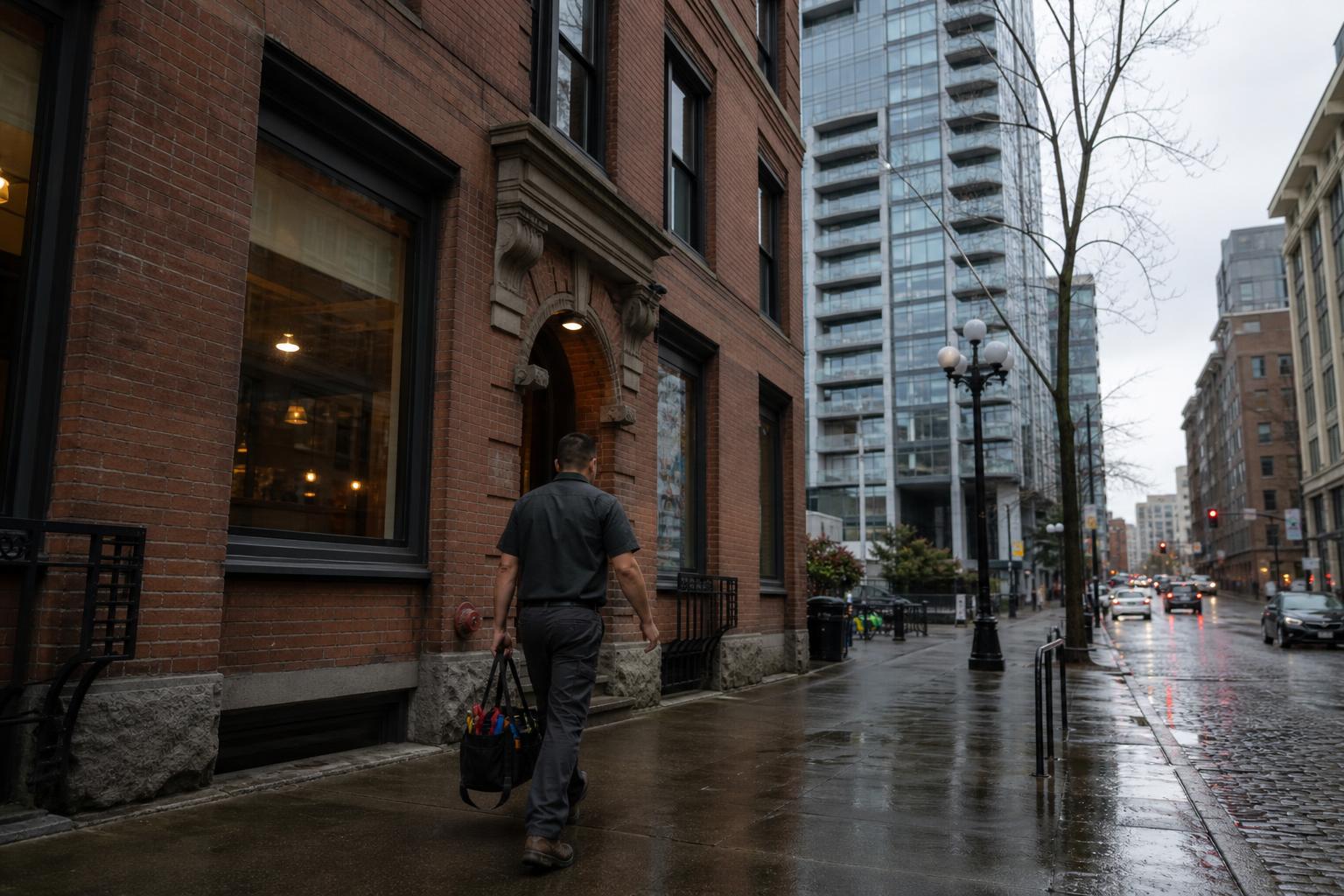
Downtown Seattle is really two neighborhoods. North of Yesler Way it’s condo and apartment towers built from the 1980s on, stacked units with shared risers and water heater closets. South of Yesler, Pioneer Square is a National Historic District of brick and stone buildings put up after the Great Fire of 1889, many converted to loft-style condos, sitting on fill land at the edge of Elliott Bay. Nic’s Plumbing works both sides of that line, and plans each visit around which one you’re in.
- ZIP codes98101 (retail and financial core), 98104 (Pioneer Square and south downtown)
- Housing era1980s–2020s high-rise and mid-rise condo towers, plus late-1800s to early-1900s brick and stone buildings in Pioneer Square, some converted to loft condos
- Most common callsIn-unit fixture and water heater work in the towers; older cast-iron drain and below-grade water issues in Pioneer Square
- How work gets approvedGood / Better / Best digital pricing, plus building or HOA coordination where a job needs it
Two downtowns, two sets of plumbing problems
The tower stock along 2nd, 4th and 5th Avenue is almost entirely modern copper or PEX, run through vertical shafts that serve dozens of units. No galvanized corrosion to worry about, but a leak in your unit can just as easily start above you, and your water heater is usually a tank in a closet rather than a basement unit. Pioneer Square is a different job. Blocks around Occidental Square, near Smith Tower and King Street Station, sit on land raised and filled after the 1889 regrade, and the buildings above still carry original cast-iron drain stacks and supply branches under a century of partial updates. Below-grade retail spaces and basements down here sit close to the water table, so a slow drain or a wet floor can be a capacity or groundwater issue rather than a simple clog.
What we hear from downtown callers, tower or loft, is the same worry: they don’t know what they’re looking at and want a sanity check before approving anything. In a building with an HOA or a property manager, there’s a second question, is this mine to fix or the building’s, and we sort that out on the visit before anything is quoted.
Pioneer Square note: old buildings on fill land
A brick building near Pioneer Square doesn’t have the crawlspace access of a Ballard bungalow, but it can carry the same original cast-iron stacks and mixed-era supply branches. We check the actual condition of what’s there, including how it handles rain and groundwater below grade, before recommending anything. Not sure what your building has? Start with our guide to side sewers in Seattle.
The services we run most often downtown
Standard service calls and fixture repair
Faucets, toilets, disposals, and the in-unit leak under a sink or behind a stacked washer/dryer make up most tower calls. See standard service calls and fixture repair.
Water heater installation and swaps
In-unit tank replacements in a closet, and tankless conversions where venting allows, come up constantly in towers and lofts alike. See water heater installation and efficiency upgrades.
Sewer and drain diagnosis for older buildings
Cast-iron stacks and side sewers under Pioneer Square’s older buildings need a camera and a real diagnosis, not a guess. See main sewer line and trenchless repair.
Whole-house repiping applies mainly to Pioneer Square’s pre-1920s buildings still running original supply branches, and heavy-rain drainage support matters most for below-grade spaces near the waterfront. See old-home pipe mitigation and repiping or heavy-rain drainage support if either fits your building.
A slow drain or a wet spot: three ways we handle it
What we recommend depends on where the problem is, how old the line is, and whether it’s likely to come back. We look first, then lay out what each path means for your unit or building.
Clear it and confirm the cause
Clear the blockage or leak, camera-check the line it’s coming from, and confirm whether it’s isolated or part of a larger pattern.
- Line cleared or leak stopped at the source
- Camera inspection of the affected run
- Written note on what caused it
Repair the failing section
Where a cast-iron joint, branch line, or fixture connection is the real failure point, replace that section instead of clearing it again next year.
- Everything in Good
- Failing section repaired or replaced
- Nearby joints checked for the same wear
Full diagnosis with building coordination
For an issue tied to a shared riser, a building side sewer, or recurring below-grade water, we coordinate with your HOA or property manager and document the source.
- Everything in Better
- HOA / property manager coordination and documentation
- Root cause addressed, not just the symptom
Whichever tier fits, you get a written digital quote before we touch anything, so the number you approve is the number on the invoice. See how our free Good / Better / Best quote works.
How a visit works downtown
Building access is the first thing we plan around. We confirm ahead of time whether your building needs a certificate of insurance, a freight elevator reservation, or a front-desk check-in, and we send a live tracking link when the tech is on the way. Tech en route · live map A canvas floor runner goes down before anyone crosses your floors, tower or Pioneer Square loft, and the tech traces what’s actually there before recommending anything. You get Good, Better and Best options in writing before work starts.
Photos of the fixture, riser, or drain line in question, its condition, and the shutoff we’ll use.
The same spot with the repair complete, labeled shutoffs, and the workspace sanitized before we leave.
Leak, water heater trouble, or a slow drain downtown?
We’ll trace what your unit or building actually has, coordinate with your HOA or property manager if needed, and send Good, Better and Best options to approve before any work begins.
More on the services downtown calls for most
Plumbing repair and service calls
Faucets, toilets, disposals, and in-unit leaks handled without disrupting the building.
Water heater installation
Tank swaps and, where venting allows, tankless conversions sized to your closet.
Side sewer and drain-line repair
Diagnosis for shared risers and older cast-iron stacks in Pioneer Square buildings.
Nearby neighborhoods
See the full Seattle service area map for all eight neighborhoods we work in.
Questions downtown residents ask
Do you work with condo HOAs and property managers downtown?
Regularly, on both sides of Yesler Way. We confirm what your building requires, a certificate of insurance, a freight elevator reservation, or a front-desk check-in, before the visit, and coordinate any riser or building-wide shut-off with management or your HOA.
Is plumbing in a Pioneer Square building different from a modern tower?
Often, yes. Many Pioneer Square buildings date to just after the 1889 fire and still run original cast-iron stacks and older supply branches. A tower a few blocks north is almost always copper or PEX on shared risers. We check what’s actually there before recommending a fix, since a recurring clog can be a capacity issue, not a simple blockage.
Why does my below-grade space near Pioneer Square get water in heavy rain?
Much of Pioneer Square sits on land filled and raised after the 1889 regrade, close to Elliott Bay’s water table, so below-grade spaces there can be more prone to water intrusion than a hillside basement. We check whether it’s drainage, sewer capacity, or groundwater before recommending work; current city drainage rules are worth checking directly for your building.
My ceiling has a water stain but nothing is leaking in my unit. What’s going on?
In a stacked building, that’s often coming from the unit above rather than your own plumbing, especially where units share a riser. We trace the source before recommending any work, and tell you plainly if the fix belongs to your neighbor or the building.
Can you replace my in-unit water heater without shutting off water to the whole building?
In most downtown towers, each unit has its own shutoff on the water heater and supply line, so a standard swap only affects your unit. A few older buildings and lofts share a single riser shutoff; we’ll tell you before scheduling if that’s the case for yours.
What should I expect on a first visit downtown?
The same standard everywhere: a live tracking link before the tech arrives, a floor runner down before anyone crosses your space, a plain explanation of what’s happening, and Good, Better and Best options in writing before work starts. See what to expect on a first visit for the full walkthrough.