
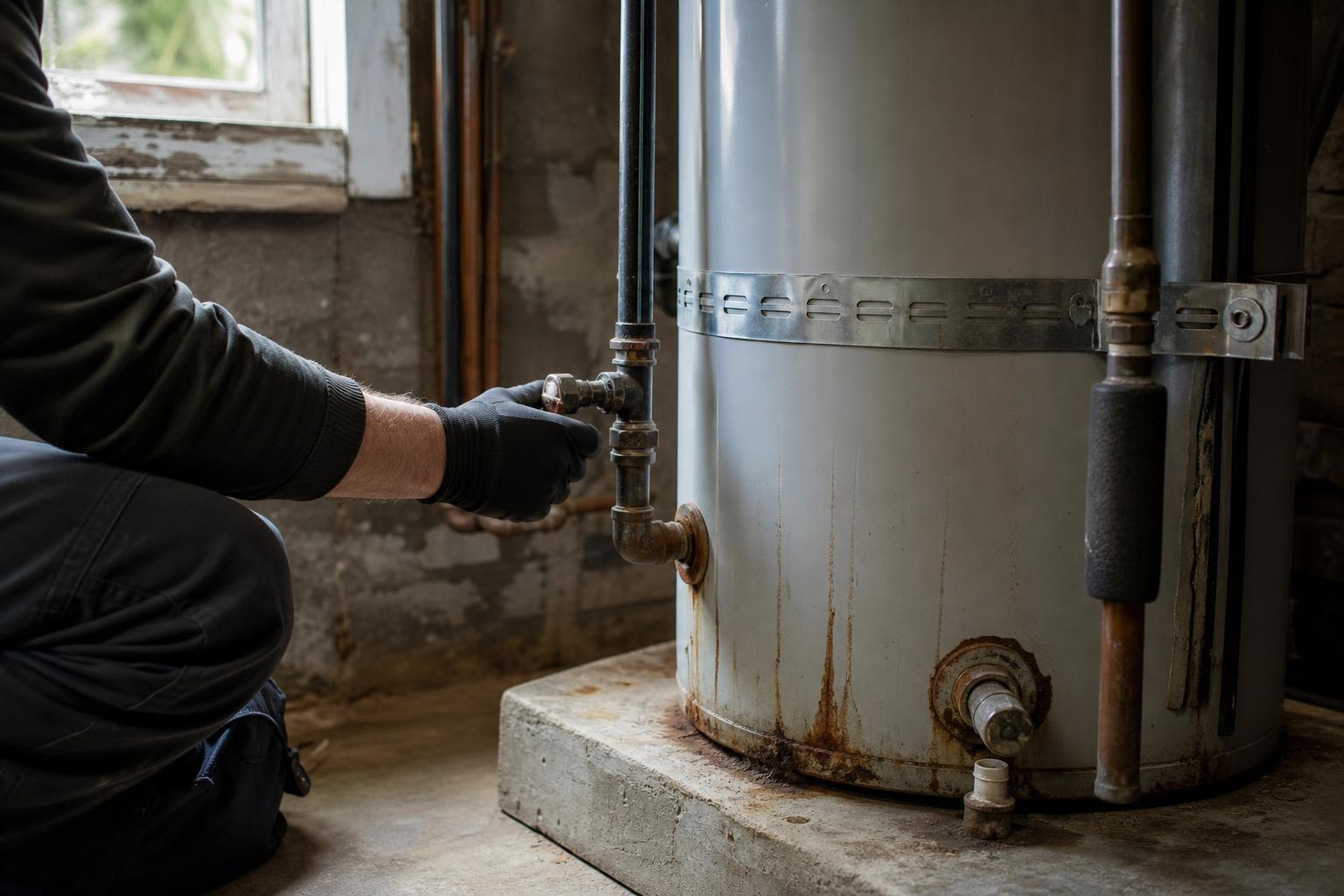
Most homeowners don’t think about their water heater until it fails, usually as a puddle on the utility room floor at the worst possible moment. But a water heater rarely dies without warning. It tells you first: rumbling sounds, water that runs rusty, a slow rise in the gas or electric bill. Here’s how long each type actually lasts, the signs that yours is on its way out, and what to weigh if you’re deciding between a straight replacement and a more efficient upgrade.
- Standard tankTypically 8–12 years for gas, a bit longer for electric
- TanklessOften 15–20 years with regular descaling
- Heat pump tankTypically 10–15 years
- Biggest lifespan factorAnode rod condition and how much sediment has settled in the tank
How long should a water heater actually last
The type of unit sets the baseline. A standard gas tank generally runs 8 to 12 years before the tank itself starts to fail; electric tanks often stretch a little longer, with no burner or flue to wear out. A tankless unit has no tank to corrode, so with the yearly descaling it needs it can commonly reach 15 to 20 years. A heat pump water heater sits in between, typically 10 to 15 years, since it’s still a tank at its core with a compressor doing extra work on top.
Those ranges assume at least some maintenance. Age alone isn’t the whole story, but it’s the first thing we check when a homeowner asks whether to repair or replace. In many Queen Anne, Magnolia and Ballard homes, the water heater has already been swapped once and sits on supply lines that are still original galvanized — so we check the lines feeding it too, since a corroded shutoff can shorten a brand-new unit’s life.
The warning signs homeowners describe before a failure
In plumbing and home-repair forums, the story is almost always the same before a tank fails: a homeowner noticed something off weeks earlier and didn’t connect it to the water heater until it was too late.
- Age past 10–12 years on a standard tank, especially if you don’t know the install date.
- Rumbling or knocking sounds, usually sediment hardening at the bottom and burning against the element or burner.
- Rusty or metallic-tasting hot water, which can mean the tank itself is corroding, not just the supply pipes.
- Water pooling at the base of the tank, even a small amount — a sign the tank has started to fail.
- Lukewarm water or a shorter hot shower than the house used to get, often a failing element or sediment eating into capacity.
- A slowly climbing energy bill with no other explanation.
One or two of these on their own aren’t an emergency. Several at once, especially on a tank past its expected age, is usually the point where repair stops making sense.
The anode rod and sediment: what actually decides the lifespan
Every standard tank has a sacrificial anode rod whose only job is to corrode instead of the steel tank around it. Once it’s used up, the tank becomes the next target — checking and replacing that rod every few years is the cheapest thing that extends a tank’s life, and it’s often skipped simply because nobody told the homeowner it existed. Sediment does similar damage from the other direction: minerals settle to the bottom, insulate the water from the heat source, and force the unit to work harder until the layer hardens and traps heat against the tank wall. An annual flush keeps that layer thin.
Repair or replace: how we help you decide
A single failed element or thermostat on a young tank is almost always worth repairing. A tank past 10 years showing rust, sediment noise or a slow leak isn’t, since repair costs can approach what a new unit would run without solving the corrosion underneath. We look at age and condition, tell you plainly which side of that line yours sits on, and if replacement makes sense, lay out real upgrade options rather than defaulting to the cheapest tank on the truck.
Standard tank, like-for-like
A direct swap, same fuel and size — the straightforward path when the space and connections already work.
Tankless
No storage tank to corrode or scale, endless hot water — worth weighing against gas line and venting realities in an older house.
Heat pump water heater
Pulls heat from the surrounding air instead of burning gas, using a fraction of a standard tank’s energy in the right space.
Both have real trade-offs in older Seattle homes — gas line and panel capacity for tankless, air volume and drainage for a heat pump unit. More in tankless vs. tank water heaters and heat pump water heaters in Seattle.
What an efficiency upgrade can save, and where the help is
Seattle City Light offers a $750 rebate on a qualified Tier 3 or 4 heat pump water heater — contractor instant discount, DIY coupon, or an online form within 93 days of purchase, one per customer; confirm the current amount with City Light before counting on it. Washington’s income-qualified HEAR program also lists heat pump water heaters as an eligible measure through local administrators, though it publishes no dollar figure — we can point you to where to check eligibility.
Code requirements on any water heater we install
King County requires two 20-gauge seismic straps (upper and lower third of the tank), an expansion tank on closed systems, and a temperature-and-pressure relief discharge to an approved termination. These apply whether you’re replacing like-for-like or upgrading, and we handle them as standard on every install.
What efficiency and lifespan mean side by side
| Type | Typical lifespan | What shortens it |
|---|---|---|
| Standard gas tank | 8–12 years | Skipped anode rod checks, sediment buildup, hard-working municipal pressure |
| Standard electric tank | 10–15 years | Same as gas, without flue or burner wear to add to it |
| Tankless | 15–20 years | Skipped annual descaling, especially with harder water |
| Heat pump tank | 10–15 years | Sediment in the tank portion, and a mechanical room too cold or too small for it to run efficiently |
What the photo documentation shows on a water heater job
The aging unit in place: rust at the fittings, sediment on flush, strap condition, and the connected shutoffs and lines.
The new unit installed to code — straps, expansion tank, TPR discharge — connections labeled, rebate paperwork filed for you.
Not sure if yours needs a repair or a replacement?
Tell us the age and what you’re noticing, and we’ll look, explain what we found, and send Good, Better and Best options to approve before anything is installed.
Related water heater reading
Water heater installation & efficiency upgrades
The full service overview and old-house realities.
Tankless vs. tank water heaters
Gas line sizing, venting, and recovery versus endless hot water.
Heat pump water heaters in Seattle
How they work, where they go, and the $750 rebate.
Questions homeowners ask about water heater lifespan
How do I find out how old my water heater is?
The serial number on the manufacturer’s sticker usually encodes the manufacture date, though the format varies by brand. Send us a photo of the sticker and we’ll tell you the age and what condition to expect.
Is it worth repairing a water heater over 10 years old?
Depends what’s failing. A thermostat or element is usually worth fixing on its own. Rust, a tank-seam leak, or heavy sediment noise past 10 years usually isn’t, since you’d be paying to repair a tank that’s already corroding from the inside.
Do tankless water heaters really last longer?
Generally yes, often 15 to 20 years against 8 to 12 for a standard tank, mainly because there’s no storage tank to corrode. That lifespan depends on annual descaling — skip it and the advantage shrinks.
What is the Seattle City Light rebate for a heat pump water heater?
As of our last check, $750 on a qualified Tier 3 or 4 unit for residential customers, one per customer, via contractor instant discount, DIY coupon, or an online form within 93 days of purchase. Terms change, so confirm the current figure with City Light, and we’re glad to help you file it.
Do I need a permit to replace a water heater in Seattle?
Yes, through Public Health – Seattle & King County, and code requires two seismic straps, an expansion tank on closed systems, and a proper TPR discharge line regardless of unit type. We handle the permit and code items as standard on every install.