
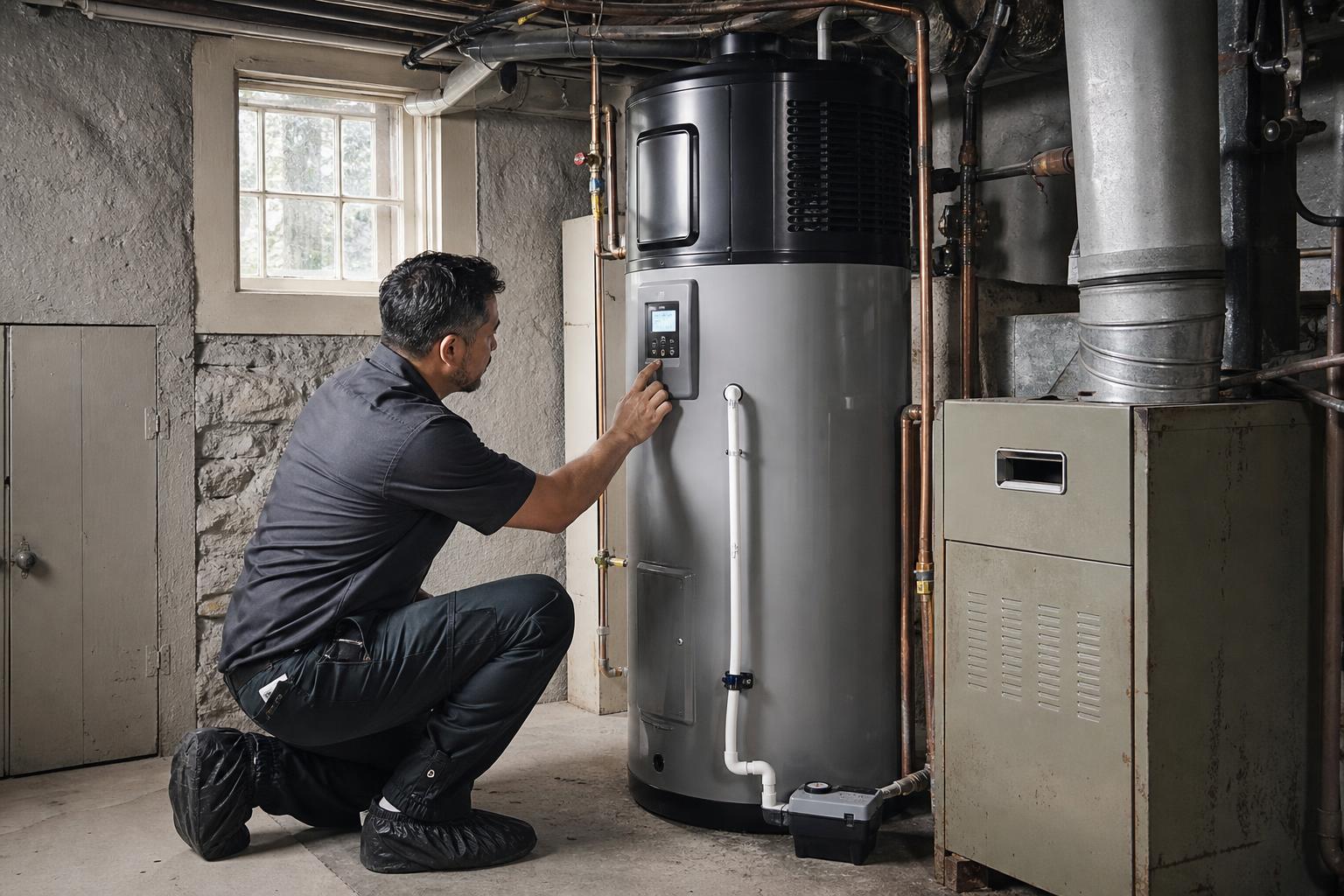
A heat pump water heater doesn’t burn anything to make hot water. It pulls warmth out of the air around it, the way a refrigerator works in reverse, which is why it can run for a fraction of what a standard electric tank costs to operate. In a Seattle basement or garage, that trade comes with a few real questions: is there enough air volume, will it hum all night next to the furnace, and where does the condensate go. Nic’s Plumbing walks through all of it before recommending one for your house.
- How it worksPulls heat from surrounding air instead of burning gas or using pure electric resistance
- Space neededWants a roomy, unconditioned space with real air volume around it — basement, garage or utility room
- Seattle rebateSeattle City Light offers $750 on a qualified Tier 3 or 4 unit, one per customer
- Other helpWashington’s income-qualified HEAR program covers heat pump water heaters too
How a heat pump water heater actually works
Sitting on top of a standard-looking tank is a small heat pump: a fan pulls in room air, a refrigerant loop absorbs the warmth out of it, and that heat transfers into the water below. Electric resistance only kicks in as backup, when demand outpaces what the heat pump alone can deliver, which is why it typically uses a fraction of the electricity a standard electric tank does. The trade-off is that it pulls heat out of the room it sits in, cooling and dehumidifying that space a little as a byproduct — which is exactly why placement matters more here than with a gas or standard electric tank.
Old-house note: air volume around the unit
Manufacturers spec a minimum room size for a heat pump water heater to draw enough air without starving itself or over-cooling a small space. A lot of Seattle basements were built as storage and laundry, not mechanical rooms, and a furnace, a washer and dryer, and shelving can eat up the open air a heat pump unit wants. We measure the actual space before recommending one, and we’ll tell you plainly if ducting the intake and exhaust, or a standard tank instead, is the better call for your house.
Does Seattle’s climate work in its favor?
Mostly, yes. A heat pump water heater draws heat from the room around it rather than outdoor air, so it isn’t fighting freezing temperatures the way an outdoor space-heating heat pump can in a cold snap. Seattle’s mild year-round temperatures give the unit a reasonable amount of ambient warmth to work with most of the year, in a basement or a garage alike. The one place it works harder is a basement that stays genuinely cold through winter — a colder room means less to draw from, so the unit leans on backup electric resistance more often and gives up some of the efficiency gain. We’ll tell you honestly whether your mechanical room runs warm enough to earn its keep.
Basement, garage, or utility room: where it actually goes
Three things decide placement: air volume, noise, and where the condensate can drain. The unit needs open room to breathe, which points toward an unfinished basement or a garage over a cramped utility closet. It also needs somewhere to send the water it pulls from the air as it runs; a nearby floor drain or condensate pump makes the install straightforward, and their absence just means we add one rather than ruling the unit out.
Noise is the other factor. A heat pump water heater runs closer to a dishwasher than a silent gas tank, mostly the compressor and the fan — rarely an issue in a garage or basement mechanical room, but worth flagging if that space shares a wall with a bedroom or a converted living area, which is common in older Seattle homes added onto over the decades.
Good, Better, Best for a heat pump water heater install
Direct swap where the space already works
The straightforward path when the mechanical room already has the air volume, an existing drain, and a spot the tank already occupies.
- Qualified Tier 3 or 4 unit sized to your household
- New shutoff, flex connectors, seismic straps and expansion tank to code
- Old unit hauled away, permit and inspection handled
- Help filing for the Seattle City Light $750 rebate
Install with drainage added
For spaces with the air volume but no existing floor drain, so the condensate has somewhere to go without ponding on an old basement floor.
- Everything in Good
- Condensate line or condensate pump installed and routed
- Dedicated 240V circuit added or confirmed for the compressor
- Placement checked against nearby finished or converted rooms for noise
Full mechanical room upgrade
For a tight utility closet or basement corner that needs real work to give the unit the air, drainage and power it’s designed for.
- Everything in Better
- Intake/exhaust ducting where the room itself is too small
- Electrical panel reviewed and upgraded if the circuit isn’t available
- Before-and-after photos of every connection
Each tier is a written digital quote you approve before anything starts, and we handle the paperwork for the Seattle City Light $750 rebate on a qualifying unit as part of the job. If your household may qualify for Washington’s income-qualified HEAR program on top of that, ask us and we’ll point you to where to check — we don’t administer that program, so we won’t quote you a dollar figure for it.
What the photo documentation shows
The existing water heater and the room around it: the available floor space, the nearest drain or lack of one, the electrical panel’s breaker room, and the airflow the new unit would have to work with.
The installed heat pump unit, the condensate routing, the new 240V circuit, the seismic strapping and expansion tank, and the inspection sign-off.
Heat pump vs. standard tank vs. tankless
| Consideration | Heat pump | Standard tank | Tankless |
|---|---|---|---|
| How it heats water | Pulls heat from room air; electric backup | Gas burner or electric element | Heats on demand at the burner or element |
| Typical operating cost | Lowest of the three, most months | Higher, especially electric-only tanks | Lower than a standard tank, higher than heat pump |
| Space requirement | Needs real air volume around it | Standard floor footprint | Wall-hung; frees up floor space |
| Effect on the room | Cools and dehumidifies it slightly | None | None |
| Noise | Compressor and fan, like a dishwasher | Quiet | Quiet |
| Rebate available in Seattle | Seattle City Light $750 on qualified units | None | None |
Curious how a gas-line-and-venting tankless conversion compares instead? See tankless vs. tank water heaters.
Wondering if a heat pump water heater fits your house?
We’ll measure the space, check the electrical, and send Good, Better and Best options in writing, rebate paperwork included.
Go deeper on water heaters
Water heater installation & efficiency upgrades
The full overview of tank, tankless and heat pump options in Seattle.
Tankless vs. tank water heaters
The gas-line, venting and electrical realities of a tankless conversion.
We install heat pump water heaters from Queen Anne and Magnolia to Ballard, Fremont, Wallingford, South Lake Union, Belltown and Downtown. See all service areas.
Questions homeowners ask about heat pump water heaters
Is a heat pump water heater actually worth it in Seattle?
For most households, yes, if the mechanical room has the space for it. It typically uses a fraction of the electricity a standard electric tank does, Seattle’s mild climate keeps it working efficiently most of the year, and the $750 Seattle City Light rebate on a qualifying unit lowers the upfront gap. The exception is a genuinely cold, cramped basement with nowhere for the unit to draw air, where a standard tank or tankless may be the better fit.
Does Seattle City Light really give a rebate for these?
Yes. Seattle City Light offers $750 toward a qualifying Tier 3 or 4 heat pump water heater, either as an instant discount through a participating contractor or by filing the rebate form within 93 days of purchase, one rebate per customer. We handle the paperwork on your job so you’re not chasing it yourself.
Is there other help besides the Seattle City Light rebate?
Washington’s income-qualified HEAR program can also apply to heat pump water heaters for households that meet the income threshold. We don’t administer that program and won’t quote you a dollar amount for it, but we’ll point you to where to check your eligibility so you can stack it with the Seattle City Light rebate if you qualify.
Will it be too loud in my basement or garage?
It runs more like a dishwasher than a silent gas tank, mostly the compressor and fan. That’s rarely noticeable in a garage or basement mechanical room, but it matters more if the space shares a wall with a bedroom or finished room. We’ll flag that during the walkthrough if it applies to your house.
What if my basement doesn’t have a floor drain, or I need an electrician for the circuit?
Neither one rules the unit out. If there’s no floor drain nearby, we install a condensate line or a small pump for the water the unit pulls from the air. And since a heat pump water heater needs a dedicated 240V circuit, we check what your panel already supports and add or confirm the circuit ourselves — one job, one quote, no separate electrician to coordinate.