“Endless hot water” sounds like an easy upgrade until someone actually looks at your gas line, your vent path and your electrical panel. In a Queen Anne foursquare or a Ballard bungalow, the honest answer to tankless vs. tank usually comes down to what is already running to that utility closet, not which unit is newer. Nic’s Plumbing checks the house first, then lays out real options in writing so you are choosing between two good answers, not guessing.
- TankStores and reheats water; recovery time depends on tank size and burner or element
- TanklessHeats water on demand; needs a bigger gas line or dedicated circuit and proper venting
- Old-house factor1920s gas services and electrical panels were rarely sized for a tankless burner
- How we quoteGood, Better and Best options in writing, approved before any work
Signs it is time to decide
- A tank that is running out of hot water sooner than it used to
- A unit old enough that you are budgeting for it rather than reacting to it
- A utility closet or basement corner where the floor space matters
- A remodel or added bathroom that has changed what the household actually draws
Why this decision is harder in an older house
The story comes up again and again in different words: someone wanted a rough number on a tankless conversion and instead got told it was “virtually impossible” in their basement closet, with no real explanation why. It usually isn’t impossible. It’s that a 3/4-inch gas line sized for a 40-gallon tank often can’t feed a tankless burner without upsizing, and a chimney that used to vent both the furnace and the water heater can draft poorly once it’s carrying just the water heater on its own. Rather than spell that out and price it, some companies just wave the idea off.
Electrical capacity matters too, even on a gas-fired tankless unit, which still needs power for its ignition and controls. And an electric tankless unit is a different conversation entirely: it can draw more than a 1920s panel has room for, especially in a house that hasn’t been upgraded to 200-amp service. None of this rules tankless out. It just means the real question is not “tank or tankless” in the abstract, it’s “what does my specific house need to make either one work correctly.”
Old-house note: hard water and tankless maintenance
Seattle’s water is soft, which is kinder to a tankless heat exchanger than the hard-water regions where tankless gets a bad reputation for scale buildup. It still needs an annual descaling flush through isolation valves to hold its efficiency and lifespan, something a lot of installs skip. If you’re not sure your current water heater is even the problem, start with do I really need a new water heater.
Recovery time vs. endless supply: what you’re actually choosing
A tank heater stores a set volume of hot water and reheats it as you use it. Run the tank dry with back-to-back showers and a load of laundry, and you wait for recovery. A tankless unit heats water as it flows past the burner, so there’s no tank to run out, but its output is capped by flow rate: two showers and a dishwasher at once can ask more than one unit can deliver, and it will show up as a temperature drop rather than cold water. Space is the other trade: a tank needs floor footprint, a tankless unit hangs on a wall and frees that space up, which matters in a tight Seattle basement or utility closet.
We size either option to your household and your fixtures, not to a generic chart, and we tell you plainly which one we’d choose for your house and why.
What Nic checks before quoting a conversion
Four things settle it, and none of them are on the box the unit comes in. The gas line: a 3/4-inch run sized for a 40-gallon tank often cannot feed a tankless burner without upsizing. The vent path: a chimney that used to carry the furnace and the water heater together can draft poorly with only the water heater on it, so a tankless unit usually needs its own sealed vent through an exterior wall. The electrical panel: even a gas tankless unit needs power for ignition and controls, and an electric one can ask more than a 1920s panel has room for. And the household itself, because the unit gets sized to your actual fixture count rather than a generic chart. All four go in the quote in writing.
Good, Better, Best for a tank or tankless conversion
Standard tank, replaced right
A correctly sized gas or electric tank in the same location, using the venting, gas line and electrical you already have. The straightforward path when the existing setup is sound.
- Correctly sized tank for your fixtures and household
- Seismic straps, expansion tank, TPR discharge to code
- New shutoff and flex connectors, old unit hauled away
- Permit and inspection handled
Tankless where the house already supports it
For houses where the gas line and a workable vent path are already close to adequate. Endless hot water and space back in the utility room without a major infrastructure rebuild.
- Everything in Good
- Gas line checked and confirmed adequate for the burner
- Sealed direct venting through an exterior wall
- Isolation valves installed for annual descaling
Tankless with full infrastructure upgrade
The do-it-once conversion: gas line upsized, new sealed venting run properly, and electrical checked or added, so the unit performs the way tankless is supposed to for the life of the house.
- Everything in Better
- Gas line upsized to the burner’s full demand
- Electrical circuit added or confirmed for ignition and controls
- Before-and-after photos of every connection
Each tier is a written digital quote with its own price, so you can compare a straightforward tank swap against a tankless conversion side by side before deciding anything. If a heat pump water heater fits your house better than either, we’ll say so; see heat pump water heaters in Seattle.
What the photo documentation shows
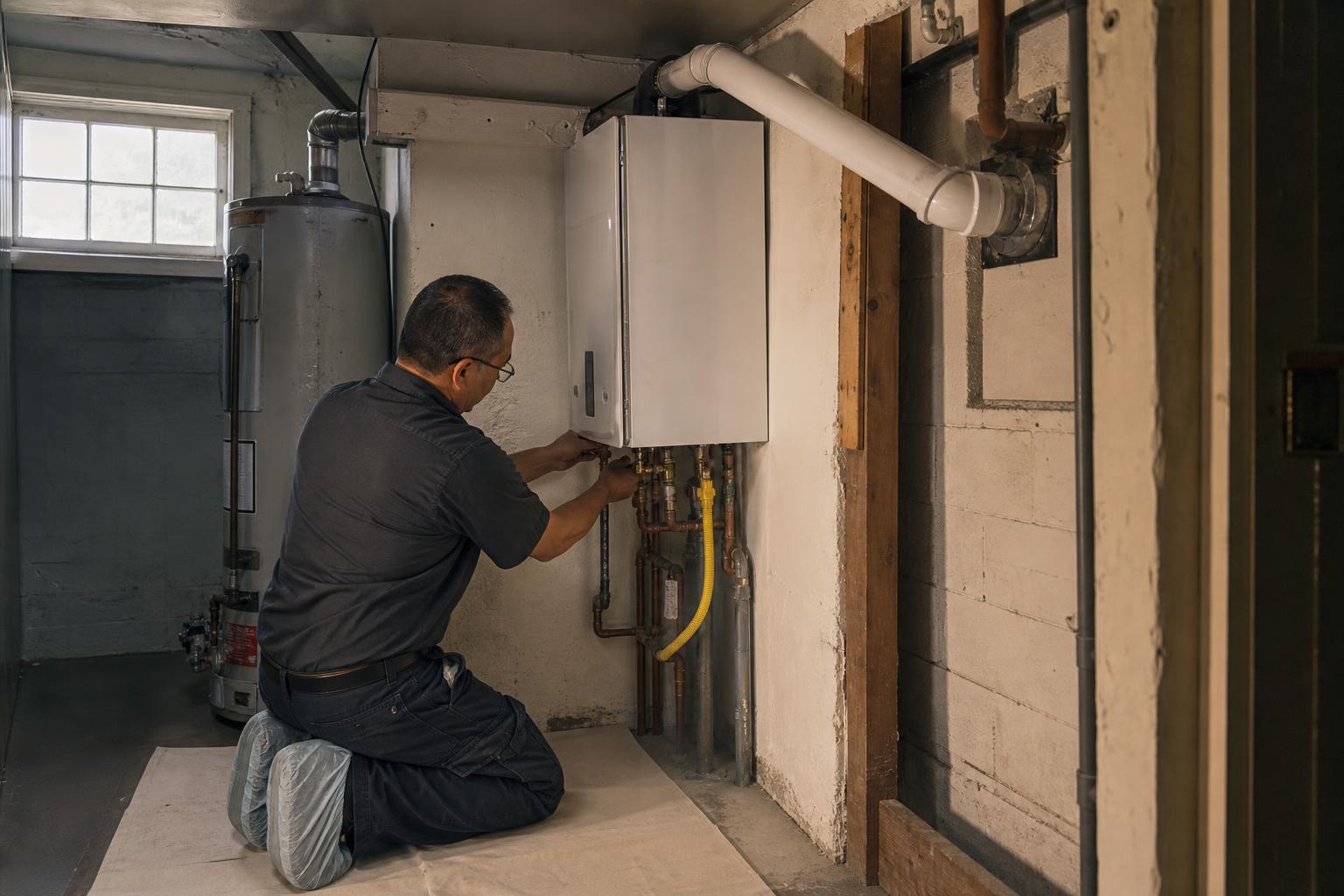
The existing tank or gas line photographed as found: its diameter, the vent path, the panel’s available breaker space, and the exact spot a tankless unit would hang if you go that direction.
The finished install: strapping and expansion tank, or the upsized gas line and sealed vent termination for tankless, plus the isolation valves and the inspection sign-off.
Tank vs. tankless, side by side
| Consideration | Standard tank | Tankless |
|---|---|---|
| Hot water supply | Fixed by tank size; recovers over time | Continuous, capped by flow rate |
| Gas line | Usually already adequate | Often needs upsizing for the burner |
| Venting in an old house | May share or reuse an existing flue | Needs its own sealed vent, usually through an exterior wall |
| Electrical panel | Minimal draw | Ignition/controls on gas units; higher draw on electric units |
| Floor space | Needs a footprint | Wall-hung; frees up the space |
| Typical service life | Often around 8 to 12 years | Often 15 to 20 years with annual descaling |
Curious how long either option should actually last, and what shortens it? See water heater lifespan and efficiency.
Weighing tankless vs. tank? Let us look at your setup.
We’ll check the gas line, the vent path and the panel, then send Good, Better and Best options in writing to approve before any work begins.
Water heater conversions are available across our full service area, centered on Queen Anne, Magnolia, Ballard, Fremont and Wallingford. For the neighborhood picture, start with plumbing in Queen Anne or Ballard, or see all service areas.
Questions homeowners ask about tankless vs. tank
Is a tankless water heater actually worth it in an old Seattle house?
It depends on your gas line, your vent path and how long you plan to stay in the house. If the infrastructure is close to adequate, the upgrade cost is modest and the endless hot water and space savings are worth it. If it needs a full gas and venting rebuild, it’s still doable, just a bigger project. We’ll give you real numbers for your specific house rather than a generic yes or no.
Someone told me tankless is “virtually impossible” in my basement. Is that true?
Usually not. It generally means the gas line needs upsizing and the vent needs to run through an exterior wall instead of the old chimney, which is real work but not impossible. Some companies would rather not price that work out, so they call it impossible instead. We’ll spell out exactly what your house needs and quote it as one of your options.
Will a tankless unit really give me endless hot water?
Yes, in the sense that it won’t run out the way a tank does, but its output is still capped by flow rate. Run two showers and a dishwasher at once and an undersized unit will show it as a temperature drop rather than cold water. We size the unit to your actual fixture count so it keeps up with how your household really uses hot water.
Does Seattle’s soft water help or hurt a tankless unit?
It helps. Soft water builds up scale on a tankless heat exchanger much more slowly than in hard-water regions, where tankless gets a reputation for maintenance headaches. It still needs an annual descaling flush through isolation valves to hold its efficiency and reach the 15-to-20-year service life these units are rated for.
Can I just swap in a tankless unit where my old tank was?
Sometimes, but it’s rarely a simple swap. The unit itself is smaller, but the gas line, the vent path and the electrical for ignition and controls all need to be right for a tankless install, and a spot that worked for a tank doesn’t automatically work for tankless venting. We check the whole setup before quoting, not just the footprint.
How do I decide between tank and tankless for my house?
Start with how long you’re staying, how much space matters to you, and what your gas line and panel currently support. A tank is the lower-effort path when your setup already suits it. Tankless earns its keep when space or endless hot water matters and your house can support the upgrade without excessive rework. We’ll walk through both with you and recommend the one that fits.
Go deeper on water heaters
Water heaters: repair, replacement and upgrades
The full overview of tank, tankless and heat pump options in Seattle.
Heat pump water heaters
How a hybrid unit behaves in a cold Seattle basement, plus the rebate details.
Water heater lifespan and efficiency
How long each type lasts and what the efficiency ratings mean.
Do I really need a new water heater?
The signs that mean replace, and the ones that mean repair.