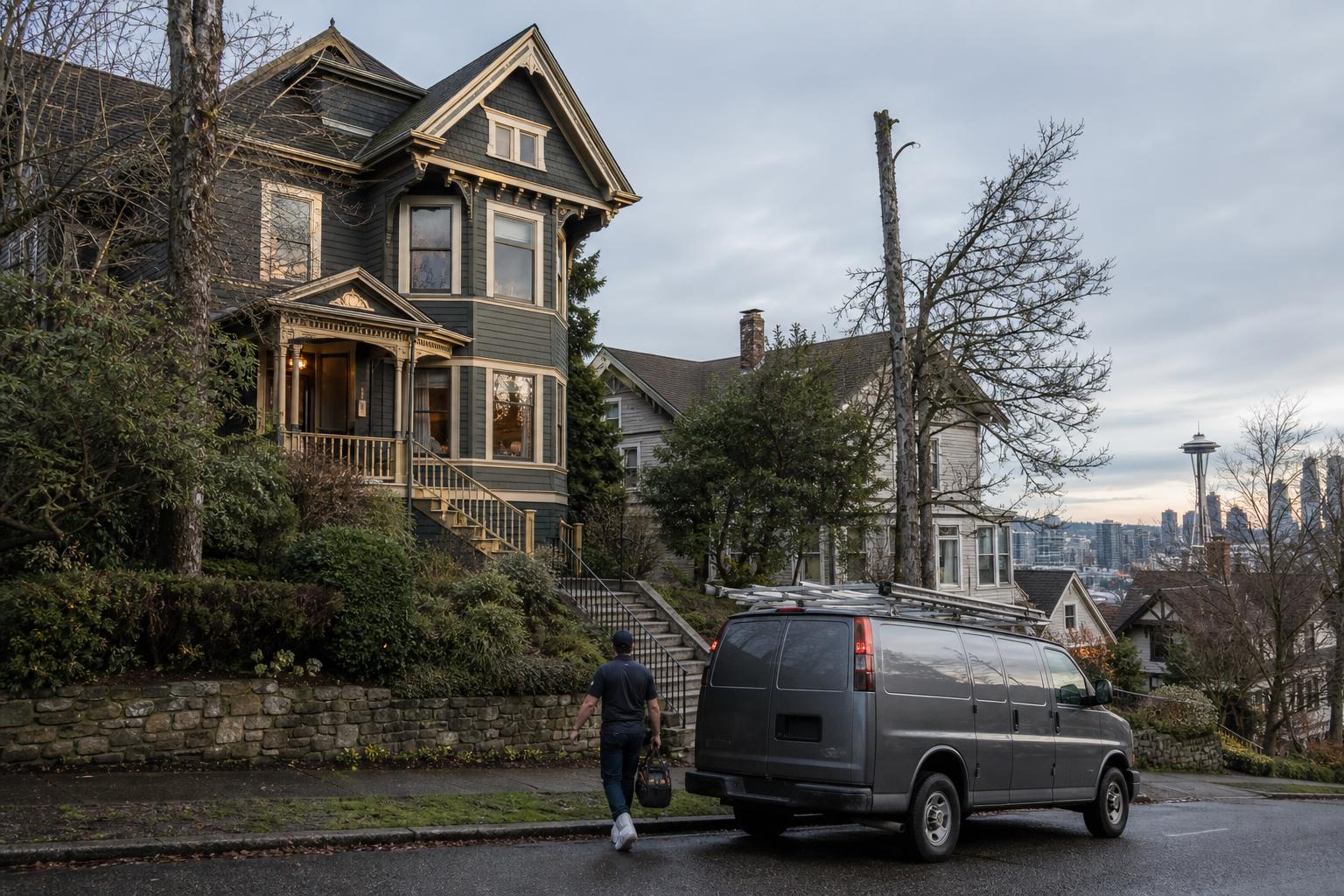
Queen Anne is one of Seattle’s oldest hilltop neighborhoods, and it plumbs like it: Victorians and foursquares from the 1900s through the 1920s climbing the slope above Elliott Bay, their original galvanized supply lines and clay side sewers still doing the work a century later. Queen Anne is the center of my service area, from the steep pitches near Kerry Park to the apartment blocks around Queen Anne Avenue N. Two things change what the pipe is doing on this hill: how old the house is, and how far up the grade it sits.
- ZIP codes98109 (Lower Queen Anne, south slope) and 98119 (Upper Queen Anne, the hilltop)
- Housing eraMostly 1900s–1920s Victorians, foursquares and craftsman homes on the hill
- TerrainSteep lots and long side-sewer runs from house to street main
- Sewer systemThe northern part of Queen Anne is in Seattle’s combined sewer basin, per Seattle Public Utilities
What Queen Anne homes are dealing with, above and below ground
Upper Queen Anne, the hilltop above Highland Drive and Bigelow Avenue N, holds most of the oldest housing stock: three-story Victorians and foursquares built when galvanized steel was the standard supply pipe. Lower Queen Anne, toward Seattle Center and the Queen Anne Avenue N corridor, mixes that same era with mid-century buildings and newer apartments. In both, one of the first questions a homeowner usually asks is whether the number in front of them is reasonable, or whether someone is about to sell them more than the house needs. That is a fair question, and it has a real answer: why two repipe quotes on the same house can differ.
Why height costs you pressure on this hill
Water arrives at the meter with a fixed amount of push behind it, and every foot it has to climb spends some of that push. Roughly, each foot of rise costs a little under half a pound of pressure, so a third-floor bathroom in a Queen Anne foursquare starts out meaningfully weaker than the kitchen tap on the main floor before the pipe is even part of the conversation. Now add a century of galvanized steel. Rust and scale grow inward from the pipe wall, narrowing the bore, and a narrower pipe costs more pressure the farther and higher water travels through it. That is why the top-floor shower goes quiet years before anyone notices anything downstairs — the two effects stack, and the top floor is where they land. It also means a pressure complaint on a three-story house is a system question, not a fixture question. See low hot water pressure in an old house.
What a steep lot does to the side sewer
The grade cuts the other way underground. A house set back and above the street has a longer, steeper side sewer run to reach the public main, and that whole run — from the house to the connection — belongs to the homeowner, not the city. More pipe means more joints, more root paths under mature street trees, and more length for an old clay line to settle out of alignment. Root intrusion and offset joints show up as slow drains long before anyone sees a wet basement. Seattle keeps side sewer cards on file for most addresses, which is often the fastest way to find out where your line actually runs before anyone digs. See what you own and what the city requires, or whether a spot repair is enough.
The same grade shapes how I get to the work. Queen Anne’s oldest lots often have a narrow side yard, steps down to the basement door, and sometimes a retaining wall between the street and the crawlspace. That is a routing question before it is a pricing one, and it gets worked out on the walkthrough rather than on the day. How a job with Nic’s Plumbing goes.
Old-house note: the combined sewer on north Queen Anne
Seattle Public Utilities puts the northern part of Queen Anne — along with Ballard, Fremont and Wallingford — in the combined sewer basin, where sewage and stormwater share one pipe. On a steep lot that matters: a heavy-rain backup and a failing side sewer produce the same symptom in the basement, so the two have to be told apart before anyone quotes a fix. See why Seattle basements flood in heavy rain.
Common plumbing needs in Queen Anne homes
Old-home repiping
Three-story pressure loss, mixed-metal joints from past remodels, and galvanized lines closing up from the inside. See old-home pipe mitigation and repiping, or the Queen Anne-specific look at repiping a hilltop house.
Side sewer and trenchless repair
Long, steep runs to the street main are more exposed to root intrusion and settling, and combined-sewer streets add heavy-rain backups. See main sewer line and trenchless repair, or trenchless vs. dig-and-replace.
Heavy-rain drainage support
Hillside grading moves stormwater fast, and older foundations weren’t built for today’s atmospheric-river storms. See heavy-rain drainage support.
Water heaters and standard service calls come up too, especially in the apartments and updated homes near Lower Queen Anne. See water heater installation or standard service calls and fixture repair.
What a symptom in a three-story Queen Anne house usually means
| What you notice | What it usually points to | How it gets checked |
|---|---|---|
| Top-floor shower fades, main floor is fine | Rise plus scale in the galvanized riser, worst at the highest fixture | Pressure readings floor by floor, camera on the riser |
| Rust in the first glass drawn in the morning | Scale shedding from a galvanized line that has sat still overnight | Draw test at several fixtures, inspection at the water heater |
| A leak in a new place every year or two | Mixed-metal joints from an old remodel corroding faster than the pipe | Trace the route and find every transition, not just the wet one |
| Slow drains that clear and come back | Roots or an offset joint in a long clay side sewer on a steep run | Sewer camera pass from the house to the street connection |
| Basement backup during a hard rain | Combined sewer surcharging, or your own line failing, or both | Camera plus a look at the drainage path around the foundation |
Upper vs. Lower Queen Anne, at a glance
| Upper Queen Anne (98119) | Lower Queen Anne (98109) | |
|---|---|---|
| Typical housing | 1900s–1920s Victorians and foursquares on the hilltop | Mixed older homes with more mid-century and newer apartment buildings |
| Terrain | Steep lots, longer side-sewer runs | Flatter, closer to Seattle Center and the Queen Anne Ave N corridor |
| Common needs | Repiping, side sewer repair, storm drainage on the slope | Water heaters, fixture repair, in-unit service calls |
Photos of the galvanized run or the side sewer camera pass, the rust or root intrusion in question, and the exact spot I plan to open.
The same location with the new line or repair in place, the pressure or camera test result, and the opening left clean for your finisher.
Old pipes, a steep lot, or a quote that doesn’t add up?
I’ll trace what your Queen Anne home actually has, explain it plainly, and send Good, Better and Best options to approve before any work begins.
Nearby: Magnolia, Fremont, Wallingford and Ballard share similar combined-sewer and old-housing questions. See the service area map.
Questions Queen Anne homeowners ask
Why does my top-floor bathroom have such weak water pressure?
On a three-story Queen Anne house with original galvanized supply lines, this is one of the most common plumbing problems there is: the rise costs pressure, and decades of scale inside the pipe cost more. It gets diagnosed with a camera and a pressure check at several floors, and you see what’s happening before anything is recommended. See old-home repiping.
Whose responsibility is the sewer line from my house to the street?
In Seattle the side sewer — the private pipe from your house to the public main — is yours to maintain, not the city’s. On a steep Queen Anne lot that run is often longer than average, which gives roots and settling more pipe to work on. What you own and what the city requires.
Do I need a permit for repiping or side sewer work in Queen Anne?
Usually. Replacing water supply piping in Seattle generally requires a plumbing permit and an inspection, and most side sewer work needs a permit as well. On a steep lot where the run reaches the street, any work in the right-of-way needs a separate SDOT permit on top of that. Permitting is handled as part of the job, and the inspection record becomes part of the house’s paper trail.
Do you work on the apartment and condo buildings in Lower Queen Anne, not just houses?
Yes. Lower Queen Anne skews newer than the hilltop, and the work there tends to be water heaters, fixture repair and standard service rather than a full repipe. You’ll see the price and approve the work before I begin, either way.