
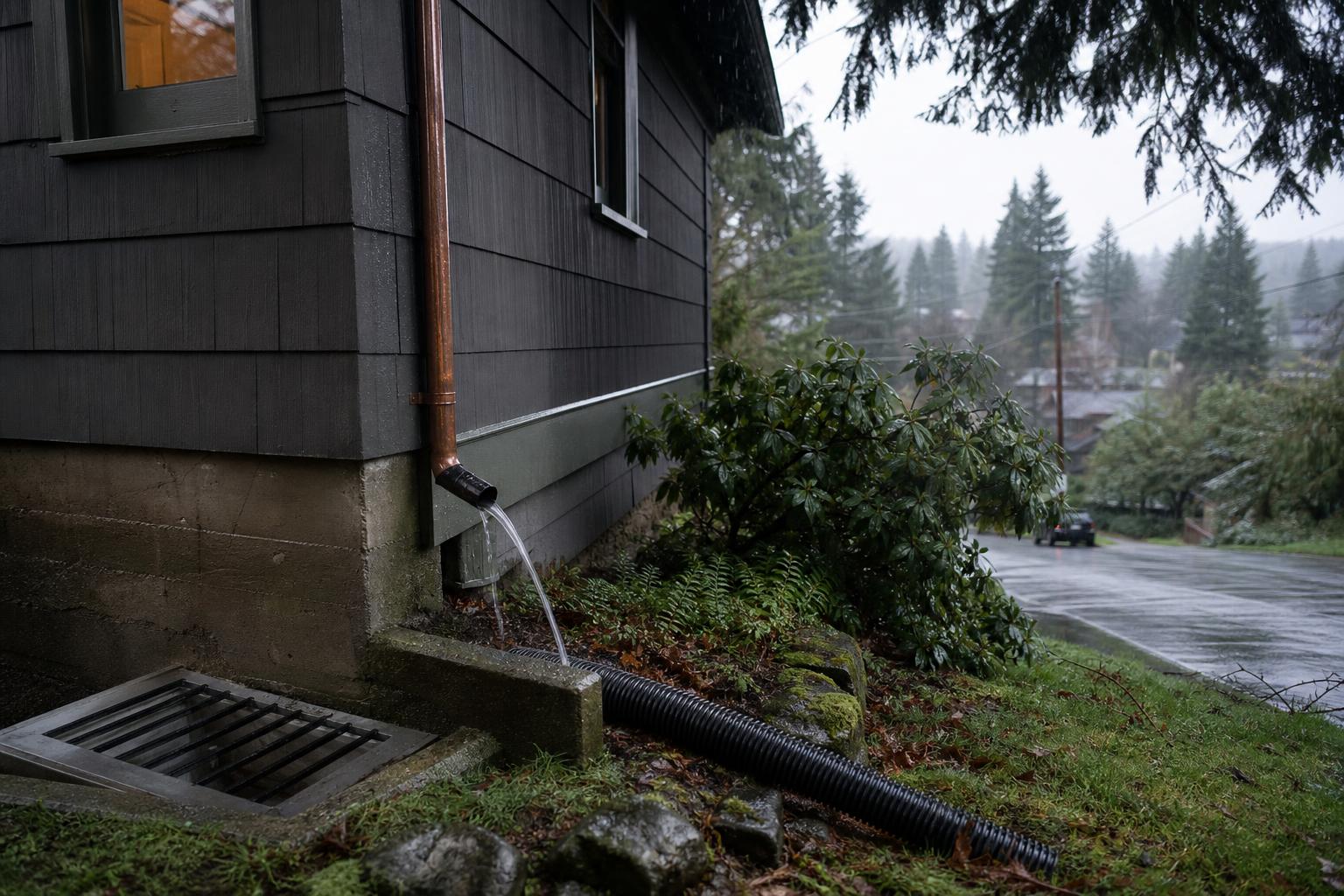
The first big atmospheric river of the season is when Seattle basements announce their problems. Water shows up at the base of the foundation wall, the floor drain in the old utility room starts to gurgle, or the daylight basement you finished last summer has a damp line along the carpet. Nic’s Plumbing handles the plumbing side of storm water in older Seattle homes: where the roof water goes, how the footing drains tie into the side sewer, and what keeps a combined sewer from backing up into your house. We look first, then quote Good, Better and Best options you approve before anything starts.
- The seasonOctober through March is when most Seattle basement water shows up
- Usual routes inDownspouts dumping at the foundation, clogged footing drains, a surcharged combined sewer
- Fix ladderDownspouts and grading first, then drains, then sump pump and backwater valve
- How we quoteA drainage assessment, then three written options approved before work
Why heavy rain finds its way into old Seattle basements
Most of the homes we work in were built between about 1900 and 1960, when a basement was a place for the furnace and the laundry, not a bedroom. The footing drains around the foundation were often clay tile, and in a lot of neighborhoods they were tied straight into the same side sewer that carries the toilets. The downspouts frequently went into that same line. Then the tile silted up or cracked, someone finished the basement, and the first hard rain of the season became a problem.
Seattle adds its own pressures. Long stretches of steady rain saturate the ground, so by January the soil against your foundation is already full and every new storm has nowhere to go but through the wall or up through the floor. Hillside lots in Queen Anne and Magnolia collect run-off from the houses above them. Daylight basements on the slope side of the house sit right in the path of that water. Crawlspaces under Ballard and Wallingford bungalows can hold standing water for weeks without anyone noticing, until the floor above feels cold and the house smells like a lake.
Old-house note: the combined sewer neighborhoods
Sewage and storm water from Ballard, Fremont, Wallingford and the northern part of Queen Anne flow into a combined sewer system that drains to the West Point Treatment Plant in Magnolia. In a heavy storm that shared pipe can fill faster than it drains, and the lowest opening in the system is often a basement floor drain or a below-grade shower. If your basement water smells like sewage rather than rain, that is the clue. A backwater valve on the side sewer is the usual answer, and we cover it in sump pumps and backwater valves for Seattle basements.
Groundwater, a plumbing leak, or a sewer backup? Telling them apart
Homeowners tell us they did not know what a sump pump was until they saw water pooling downstairs, and that they nodded along on the first visit because they did not want to admit they had no idea what they were looking at. The first thing we do is sort out which kind of water you have, because the fixes are completely different.
- Clear water at the wall or floor joint during or right after a storm points to groundwater and hydrostatic pressure. Downspouts, grading and footing drains are the suspects.
- Water rising from the floor drain, especially with a sewage smell, means the side sewer or the public main is surcharging. That is a backwater valve conversation, and sometimes a side sewer repair conversation if the line itself is damaged.
- Water that shows up in dry weather too is usually a supply leak, a failing water heater or a cracked drain line, not a drainage problem at all. We will say so rather than sell you a sump pump.
Our guide to why Seattle basements flood in heavy rain goes deeper on each of these, including what to check yourself before you call anyone.
How a drainage assessment goes with Nic’s Plumbing
Drainage is one of the easiest jobs in the trade to oversell. A homeowner with one wet corner gets a full basement waterproofing pitch and a very large number, and nobody mentions that the downspout on that corner drains straight onto the foundation. We work the other way around: cheapest likely cause first, and a written plan you can sanity-check before you decide anything.
Walk the water path
Roof to gutters to downspouts to ground, then around the foundation. We note where each downspout discharges, how the grade slopes, where window wells and stairwells collect water, and what the soil looks like against the wall.
Look at the drains and the side sewer
We locate the footing drain outlets and the floor drain, run a camera where it helps, and check how the storm water is tied into the side sewer. The city’s side sewer card for your address is public, and it can show how the original drains were connected.
Three priced options
Good, Better and Best, written down, each one describing exactly what it fixes and what it leaves for later. You approve one on your phone. The price you approve is the price on the invoice.
Protect the house, do the work
Floor runners across the finished basement, covered stairs, and the smallest openings that let us do the job properly in a slab or an old foundation wall. Outdoor trenching is planned around your plantings and hardscape, and the workspace is sanitized when we leave.
Test it, prove it with photos
We run pumps and valves under load before we go, and you get before-and-after photos of every drain, connection and pit, plus a short note on what to check each fall.
When your technician is on the way you get a live tracking link, so you are not sitting home on a rainy Saturday guessing at a four-hour window. Tech en route · live map The full standard is on our process page.
Good, Better and Best for storm drainage
Get the water away from the house
The fixes that solve a surprising share of wet basements: stop feeding the foundation, and make sure the drains you already have actually drain.
- Downspout extensions or reconnection to a working drain line
- Clear and camera the footing drain and yard drain lines
- Floor drain check and a proper cleanout
- Plain notes on grading and window-well fixes you can handle yourself
Pump it out, keep the sewer out
For basements that take water from below or from the floor drain, this adds active protection and a barrier against a surcharging sewer.
- Everything in Good
- Sump pit and submersible pump sized for the house, with a high-water alarm
- Backwater valve on the side sewer where the layout calls for one, permit included
- Discharge line routed well away from the foundation
Rebuild the drainage
For finished basements and daylight basements you want dry for good, or footing drains that have failed outright.
- Everything in Better
- Battery backup for the sump pump, so a storm-night power cut does not undo the work
- New perimeter or footing drain where the old tile has collapsed
- Storm water separated from the sanitary side sewer where the property allows
You will never see one tier presented as the only choice, and you will never see a price that is “discounted” if you sign today. Read the tiers, ask us which one we would pick for your house and why, and decide on your own time. See how the free Good / Better / Best quote works.
Downspouts, footing drains and the side sewer
| Part of the system | What goes wrong in heavy rain | What usually fixes it |
|---|---|---|
| Gutters and downspouts | Overflow, or discharge right at the foundation | Cleaning, extensions, splash blocks, or a proper drain connection |
| Footing (perimeter) drains | Old clay tile silted, crushed or root-bound; water builds against the wall | Jetting and camera check; replacement where collapsed |
| Yard and window-well drains | Clogged grates, undersized pits, wells that fill and pour in | Cleanouts, covers, re-grading, tie-in to a working line |
| Floor drain | Backs up when the side sewer or main surcharges | Backwater valve, sometimes a sump for the footing water |
| Side sewer | Carries storm and sanitary water together; cracks and roots slow it down | Camera inspection, then repair, lining or replacement |
Taking downspouts off the combined sewer
If your house is in a combined sewer basin, Seattle Public Utilities and King County run the RainWise program, which pays part of the cost of a rain garden or cistern that takes roof water off the sewer. The June 2026 program terms list rain gardens at $5 per square foot and cisterns at $0.50 per gallon of storage, each up to $5,000, and the work has to be done by a RainWise-approved contractor. Eligibility depends on your address, so check the program before you plan around it. Where a downspout disconnection makes sense for your house, we will tell you and help you sort out the plumbing side.
What the photo documentation shows on a drainage job
The downspout emptying at the foundation, the camera footage of the silted footing drain, the water line on the basement wall, the old floor drain with no valve, and the wet corner of the crawlspace.
The same downspout tied into a working line, the cleared drain on camera, the new pit and pump with its alarm, the backwater valve and its access cover, and a dry floor after the next storm.
Basement taking water this season? Get it looked at before the next storm.
We will walk the water path, tell you plainly whether it is rain, ground or sewer, and send Good, Better and Best options to approve before any work begins.
Storm drainage help across our Seattle neighborhoods
Drainage problems follow the terrain and the era of the house. These pages cover what we typically see in each neighborhood.
Sump pumps & backwater valves
Sizing, battery backup, alarms, and when a backwater valve belongs on your side sewer.
Ballard
Combined sewer basin, bungalow crawlspaces, and floor drains that back up in the first big storm.
Queen Anne
Hillside run-off, daylight basements, and a north slope that sits on the combined sewer.
Magnolia
Bluff-side lots, finished basements and long downspout runs that need somewhere to go.
Fremont
Low-lying streets near the canal and early cottages with tile footing drains.
Wallingford
Craftsman homes on the combined sewer, with basements that were never meant to be bedrooms.
We also handle drainage calls in South Lake Union, Belltown and Downtown Seattle. See all service areas.
Questions homeowners ask about basement water in Seattle
Is my basement flood groundwater, a plumbing leak, or a sewer backup?
Timing and smell tell most of the story. Water that appears only during or right after heavy rain, entering at the wall or the floor joint, is usually groundwater. Water rising from the floor drain, often with a sewage smell, is the side sewer or the public main backing up. Water in dry weather is almost always a leak inside the house. We confirm with a camera and a look at the side sewer before recommending anything.
Do I need a backwater valve in Seattle, and is a permit required?
If your home sits in a combined sewer neighborhood, or your lowest fixture or floor drain sits below street level, a backwater valve is often the right protection, and plumbing code may require one in some situations. We will tell you whether your house is a candidate rather than assume. Installing one on the side sewer generally involves a side sewer permit, which we handle as part of the job.
Will a sump pump alone stop my basement from flooding?
Only if groundwater is the problem and the pit and pump are sized for the house. A pump does nothing against a sewer backing up through the floor drain, and an undersized pit will simply lose the race in a long storm. That is why we look at downspouts, footing drains and the side sewer first, then size the pump to what is actually arriving at the foundation.
Are my downspouts connected to the sewer, and is that a problem?
In many older Seattle homes, yes. Downspouts and footing drains were routinely tied into the side sewer. It becomes a problem when that line is cracked, root-bound or surcharging, because roof water then has nowhere to go. Your side sewer card, available through the city’s public viewer, may show the original connections, and a camera confirms what is there today.
Will you tear up my finished basement or my garden to fix this?
Far less than you might fear, and never without showing you the plan first. Many fixes happen outside at the downspouts and drain lines. When a sump pit or backwater valve does mean opening the slab, we keep the cut as small as the job allows, lay runners over the finished floor, and photograph the opening before and after. Outdoor trenching is routed around plantings and hardscape wherever the grade lets us.
When should I get drainage work done, before or after the rainy season?
Late summer and early fall are ideal: the ground is dry, trenching is easier, and you are ahead of the October rains. That said, a lot of people find the problem mid-season, and we assess and fix drainage year-round. Our rainy-season plumbing checklist lists what to check yourself before the first atmospheric river.