
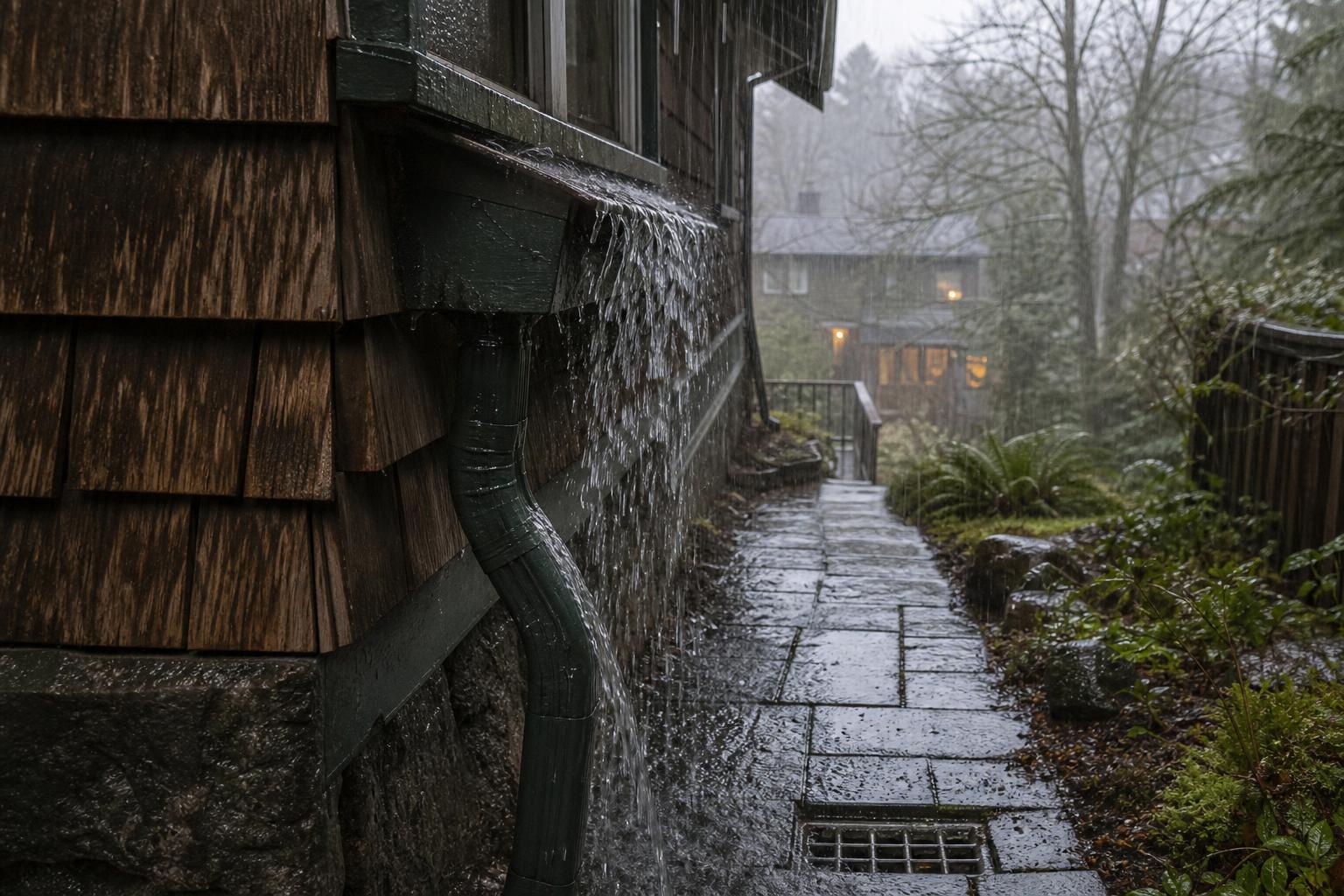
Seattle’s rain doesn’t usually arrive as one dramatic storm. It arrives as an atmospheric river: days of steady rain stacked on already-saturated ground, roughly October through April. For an older house, that steady saturation is the real test. Gutters fine in July back up in November, a crawlspace that stayed dry all summer starts weeping at the corners, and a sump pump nobody’s touched since installation suddenly has to work every night. None of this requires a flood to become a problem. It just requires the drainage path being slightly off, and the rain finding it.
- Rainy seasonRoughly October–April, with the heaviest stretches arriving as multi-day atmospheric rivers
- Combined-sewer areasBallard, Fremont, Wallingford and north Queen Anne share stormwater and sewage in one pipe
- Most Seattle homesAre crawlspace-built, not full basements, so the water shows up as a damp crawlspace rather than a flooded rec room
- Best timingCheck gutters, grading, sump and drains in September, before the first real rain
Why an old Seattle house feels the rainy season differently
Most national advice about “prepping for rainy season” is written for houses with basements. Seattle is different. A lot of our older housing stock, from Ballard and Fremont bungalows to Queen Anne foursquares, sits over a crawlspace rather than a finished basement. So the failure looks different too: not standing water in a rec room, but a musty crawlspace, a gurgling floor drain, or water finding the one low spot along the foundation that nobody noticed until the third day of rain.
There’s also a Seattle-specific wrinkle: in Ballard, Fremont, Wallingford and northern Queen Anne, stormwater and sewage share a combined sewer system headed to the West Point Treatment Plant. In normal rain that’s invisible. In a sustained atmospheric-river event, a combined system can back up under pressure, which is one more reason a struggling footing drain or side sewer becomes a problem exactly when the rain is heaviest.
If you’re in a combined-sewer neighborhood
Homes in Ballard, Fremont, Wallingford and north Queen Anne may qualify for Seattle’s RainWise program, which helps pay for a rain garden or cistern that keeps stormwater out of the combined system: rain gardens at roughly $5 per square foot and cisterns at roughly $0.50 per gallon of storage, each up to $5,000, through a RainWise-approved contractor. Confirm current eligibility and numbers with SPU/RainWise, and ask me if you’re not sure whether your address qualifies.
The before-the-rains checklist
This is roughly the order I’d walk an old Seattle house in, whether you do it yourself in September or have me look at the whole system at once.
Clear gutters and downspouts first
Almost every drainage problem in an old Seattle house traces back to this. A clogged gutter overflows right at the foundation. Clean it, check for sagging sections, and confirm every downspout actually discharges somewhere useful.
Extend downspouts away from the foundation
A downspout dumping water two feet from the house feeds your foundation drain more than it can handle. Extensions routed to daylight or the storm system take that load off before it starts.
Walk the grading around the house
Ground sloping toward the foundation, often from years of built-up mulch or landscaping, sends rainwater exactly where you don’t want it. Regrading a low spot is usually cheaper than the drainage fix that follows it.
Test the sump pump before you need it
Pour a few gallons into the pit and watch it cycle. A pump that hasn’t run since spring can seize, and an undersized pit is a common complaint: it runs, but can’t keep up once the ground is fully saturated.
Check for a battery backup
Seattle’s heaviest rain often arrives with wind, and wind means power can drop out exactly when the pump matters most. A battery or water-powered backup is what separates a brief outage from a flooded crawlspace.
Clear floor drains and confirm they’re not backing up
Run water down any floor drain in a crawlspace, utility room or garage and watch how it drains. Slow or gurgling drainage now is worth investigating before the rain adds volume.
Ask about a backwater valve if you’ve had backups before
A backwater valve stops sewage from being pushed back into the house when the side sewer is under pressure. Seattle has no blanket rule requiring one. Whether it makes sense for your home depends on fixture elevation and history, so ask rather than assume.
Get the side sewer scoped if it’s older or has backed up before
Root intrusion and offset joints worsen under sustained saturation. A camera inspection shows what’s really down there. Repairing or replacing the pipe requires a Seattle SPU Side Sewer Permit; a scope alone does not.
What I actually check on a drainage assessment
I walk the outside of the house before I look at anything inside it. Where the downspouts land, where the ground slopes back toward the foundation, whether the old drain tile still discharges anywhere. Then the crawlspace, the pit and the side sewer. Most of what I find on these visits is free to fix.
- Camera inspection of the side sewer and footing drain connection
- Sump pit size and pump capacity checked against the crawlspace
- Grading and downspout routing walked around the full perimeter
- Written notes and photos, not a same-visit sales pitch
If something needs fixing, you get it in writing as Good, Better and Best options: a sump pump swap, a perimeter drain, a backwater valve, or some combination, priced before anything is scheduled.
Normal for the season, or time to call?
| What you’re seeing | Usually normal | Worth calling about |
|---|---|---|
| Crawlspace smell/dampness | Faint musty smell after heavy rain | Standing water, mold, or a smell that lingers |
| Sump pump | Cycling more during multi-day rain | Running constantly or short-cycling |
| Floor drains | Draining a little slower | Gurgling, backing up, or sewage smell |
| Yard/foundation | Puddling that clears in hours | Water sitting against the foundation for a day+ |
| Downspouts | Steady flow out the bottom | Overflowing at the gutter or a joint |
Homeowners in online forums report a wide range for this kind of work, from around $150 for a basic sump pump swap to $6,500 to $14,000 for a full perimeter drain and sump system. Every house is different, which is why I scope yours first and send real numbers, not a guess.
Not sure your drainage will hold through another rainy season?
We’ll walk the gutters, grading, sump and side sewer, tell you honestly what’s fine, and send priced options before anything is scheduled.
Related drainage services
Heavy-Rain Drainage & Storm Protection
Full assessment and repair for crawlspaces, footing drains and floor drains ahead of the rainy season.
Sump Pumps & Backwater Valves
When each one is the right answer, battery backup options, and how a backwater valve stops sewage backing up during a storm.
Side Sewer Repair & Trenchless Replacement
Camera-scoped diagnosis and repair for roots, offsets and aging clay or Orangeburg laterals.
Questions homeowners ask before the rainy season
When does Seattle’s rainy season actually start and end?
There’s no single official date, but roughly October through April is when Seattle sees its heaviest and most sustained rain, including multi-day atmospheric-river events. September is the practical window to get gutters, grading, sump pumps and drains checked before that stretch begins.
Do I need a permit for a sump pump or backwater valve in Seattle?
It depends on whether the work touches your side sewer. Repairing or replacing side sewer piping generally requires a Seattle SPU Side Sewer Permit, and work staged in the public right-of-way can also need an SDOT permit. We handle permitting as part of the job when it applies.
My crawlspace has never flooded — do I still need to do this?
Yes, especially the free parts. Clearing gutters, extending downspouts and testing the sump pump take an afternoon and catch most problems before they start. Even a dry crawlspace can have a downspout quietly overflowing at the foundation, or a sump pit that’s never been tested under real load.
What’s the difference between a sump pump and a backwater valve?
A sump pump moves groundwater or rainwater collecting near or under the house out and away from it. A backwater valve is a one-way valve on the side sewer that stops sewage from being pushed back into the house when the system is under pressure. Many older homes benefit from one, the other, or both, depending on what’s actually causing the water.
Is my neighborhood in a combined sewer area?
Ballard, Fremont, Wallingford and northern Queen Anne share stormwater and sewage in one combined system. Other neighborhoods we serve, including Magnolia, Belltown, South Lake Union and Downtown, aren’t confirmed as combined basins, so ask me or check with Seattle Public Utilities if you’re not sure.