
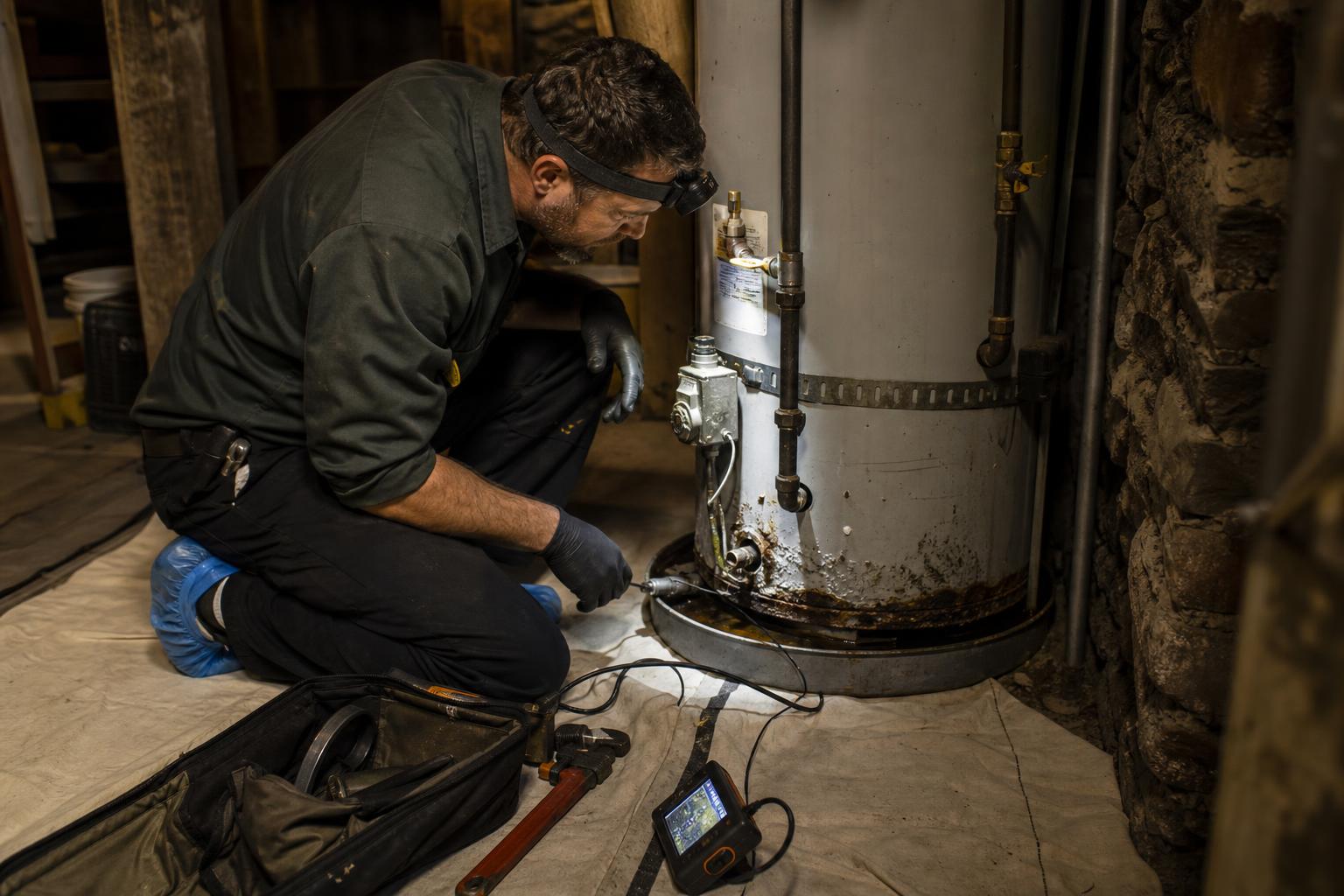
A plumber looked at your water heater and said “replace it.” Maybe that’s right. Maybe it isn’t. The honest answer depends on where the failure actually is and how old the tank is, not on whichever number is easiest to quote. Here’s how to tell a legitimate repair from a job that genuinely needs a new tank.
- Leak at a fitting or valveUsually repairable: a connection, not the tank itself
- Leak at the tank seam or bodyNot repairable: the tank is corroding from the inside and needs replacement
- Typical service lifeRoughly 8-12 years for a standard tank, shorter with hard use or a spent anode rod
- Any replacement in King CountyComes with seismic straps, an expansion tank on closed systems, and a compliant TPR discharge
Start with where the water is actually coming from
Every water heater conversation should start with the same question: is the leak at a fitting, or is it the tank? A dripping inlet, a loose union, a weeping pressure relief valve, or a failed drain valve are all connections, and connections get tightened, resealed, or swapped without touching the tank.
A leak at the tank seam, from underneath the tank itself, or water pooling in the drip pan with every fitting dry, is different. Steel tanks are lined with glass, and once that lining cracks, the steel underneath rusts and eventually lets go. There’s no patch for that; it only gets worse.
Old-house note: the anode rod is doing a job you can’t see
Every tank has a sacrificial anode rod inside it that corrodes on purpose so the steel tank doesn’t have to. Once it’s spent, the tank starts absorbing the corrosion instead. A spent rod is often the real story behind rusty hot water or an early failure, and it’s cheap to check before anyone recommends a full replacement.
What’s legitimately repairable, and what isn’t
Not every failure means the tank is done. Here’s how we sort it, before any pricing enters the conversation.
A part failed, not the tank
A thermostat, heating element, thermocouple, gas control valve, or a pilot that won’t stay lit are appliance parts, and they fail on their own schedule whether the tank is three years old or ten.
- No hot water but no leak anywhere
- Pilot won’t light or keeps going out
- Water heats too slowly or not at all
Sediment, noise, reduced capacity
A tank that rumbles, runs out of hot water faster than before, or has heavy sediment on a flush can sometimes be restored. On an older tank near the end of its life, that sediment often means corrosion has started.
- Popping or rumbling sounds during heating
- Noticeably less hot water than before
- Heavy sediment when the tank is drained
A leaking tank, at any age
Water at the tank seam, rust weeping through the steel, or a crack in the glass lining means the vessel has failed. No fitting to tighten, no part to swap; this is the one case where replacement is honest.
- Leak at the tank body or bottom seam
- Rust-colored water pooling under the unit
- Visible corrosion through the tank’s steel shell
If your plumber recommends replacement, ask exactly where the failure is. “The tank is leaking” is a reason. “It’s getting old” on its own, with no leak and no failed part, is worth a second look. See how our free Good / Better / Best quote works if you want one before deciding either way.
What we check before recommending anything
Find the water
We trace where moisture is coming from: a fitting, the drain valve, the TPR valve, or the tank itself. This alone rules repair in or out.
Check the age and the anode
The serial number gives us the manufacture date. We check the anode rod’s condition, since a fresh rod can extend a tank’s life.
Test the parts that fail
Thermostat, element or thermocouple, gas valve, and pilot assembly, tested individually before anything gets blamed on “the whole unit.”
Lay out the honest options
Repair or replace, written down as priced options with what each includes. You approve one before we touch anything.
Prove what we did
Photos of the failure we found and the fix or install, so you’re not taking our word for it.
If it is a replacement, King County adds a few required items
This part isn’t an upsell, it’s code. A replacement in King County has to include two 20-gauge seismic straps, one in the upper third of the tank and one in the lower third, an expansion tank if your system is on a closed loop, and the temperature-and-pressure relief valve piped to an approved discharge point. Plumbing work is permitted through Public Health – Seattle & King County. If a bid skips these line items, ask why, because they’ll need to be there at inspection regardless.
- Two 20-gauge seismic straps, upper and lower third of the tank
- Expansion tank on closed systems
- TPR valve discharge to an approved termination
- Permit through Public Health – Seattle & King County
Comparing a like-for-like tank against a tankless or heat pump unit? See tankless vs. tank for an old Seattle house. For the fuller picture on when a tank is nearing the end, see water heater lifespan and efficiency.
Symptom, likely cause, and what it usually means
| What you’re seeing | Likely cause | Repair or replace |
|---|---|---|
| No hot water, no leak, unit under 10 years old | Failed thermostat, element, or thermocouple | Usually repair |
| Water pools under the tank, fittings are dry | Tank seam or internal corrosion | Replace |
| Rusty hot water, tank over 8 years old | Spent anode rod, corrosion starting inside | Depends; check the rod and age first |
| Rumbling, popping, less hot water than before | Sediment buildup | Often repair (flush); replace if tank is old |
| Drip only at a valve or union, tank itself dry | Loose or worn fitting | Repair |
Not sure if yours is a repair or a replacement?
Tell us what you’re seeing, and we’ll give you a straight answer, plus a written Good / Better / Best option if replacement really is the honest path.
Related services
Water heater installation & efficiency upgrades
When replacement is the right call, three priced options and a permit-compliant install.
Tankless vs. tank for an old Seattle house
If you’re replacing anyway, the honest comparison for gas sizing, venting, and hard water.
Questions homeowners ask before replacing a water heater
My water heater is old but not leaking. Do I need to replace it now?
Not necessarily. Age alone isn’t a failure. If it’s heating properly, holding pressure, and not leaking, an older tank can often keep running, especially with a fresh anode rod. What we’d tell you honestly is whether it’s close enough to the end that planning ahead makes sense.
Can a leaking water heater ever be repaired instead of replaced?
It depends on where the leak is. A fitting, valve, or connection can be resealed or swapped. A leak from the tank body or bottom seam means the steel itself is failing, and there’s no repair for that; the tank has to be replaced.
What does the anode rod actually do, and can it save my tank?
The anode rod corrodes in place of the tank’s steel walls. While it’s intact, it takes the damage the tank otherwise would. Once it’s spent, the tank starts corroding instead, which is why rusty hot water or an early failure often traces back to a rod nobody checked. Replacing a spent rod is far cheaper than replacing the tank.
What has to come with a water heater replacement in King County?
Two 20-gauge seismic straps in the upper and lower third of the tank, an expansion tank if the system is on a closed loop, and the temperature-and-pressure relief valve piped to an approved discharge point, all under a permit through Public Health – Seattle & King County. These are code requirements, and they’ll come up at inspection either way.
How do I know if a plumber is upselling me on a replacement I don’t need?
Ask where the failure is, specifically. “The tank is leaking at the seam” is a real reason. “It’s just old,” with no active leak and no failed part, deserves a second opinion. A straight answer should point to the exact fitting, part, or spot on the tank causing the problem.