
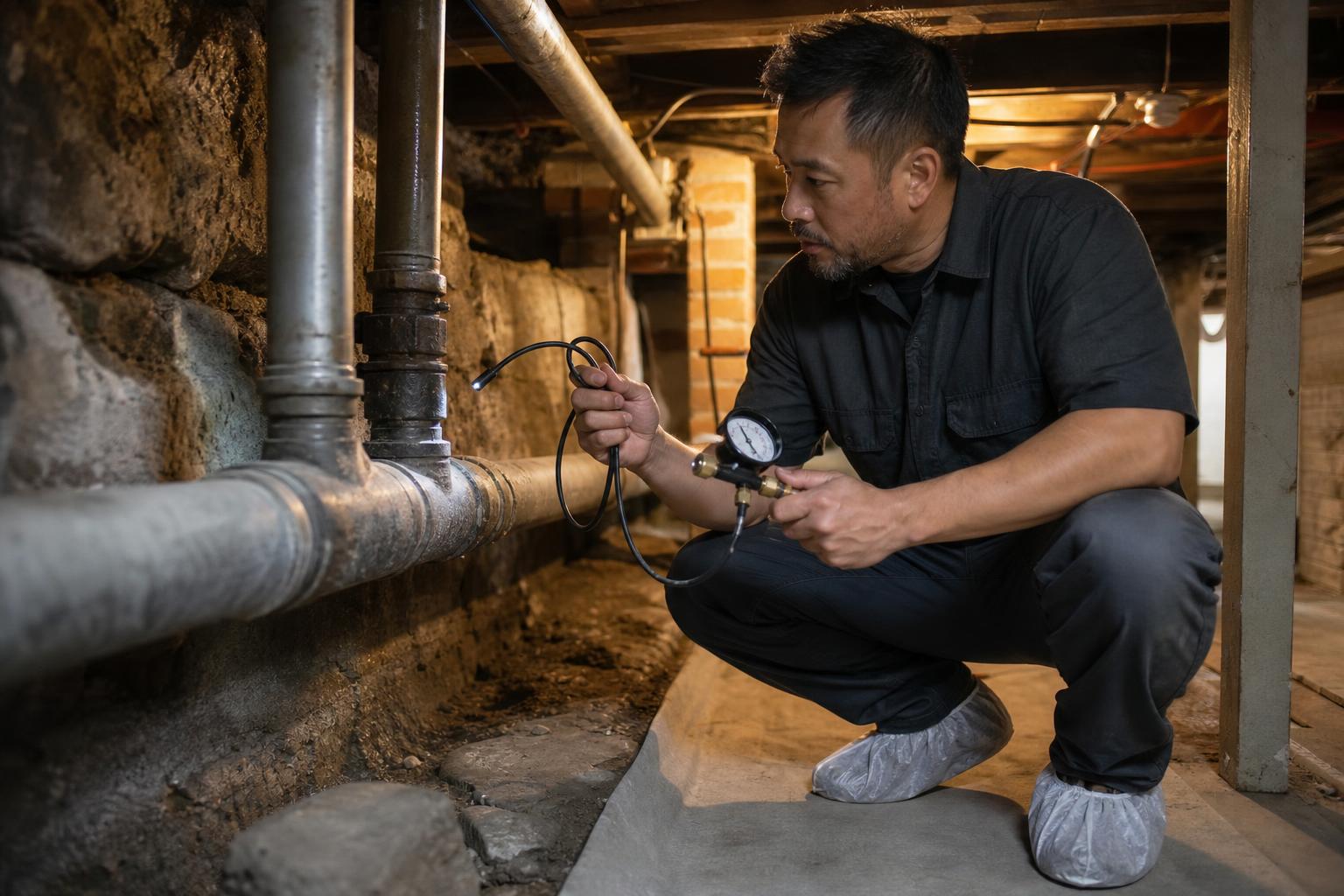
If you have galvanized pipe and nothing has actually leaked yet, the real question is not “how old is my house.” It’s whether the signs that actually predict failure are showing up. Age alone tells you the clock is running; it doesn’t tell you the pipe is about to go. Here’s the honest way to sort a proactive repipe from a wait-and-see, and what a no-pressure look checks before you spend anything.
- Age sets odds, not outcomesGalvanized supply lines went in roughly 1900–1960 in most Seattle homes, but two houses built the same year corrode at very different rates
- Leading indicatorRust or brown water on the hot side, before the cold side ever shows it
- Second indicatorPressure that drops when two fixtures run at once, worse the higher you go in the house
- Third indicatorEven one pinhole leak on an otherwise untouched system
The question we hear the most
This is the single most common question we get before anyone calls: “I’ve got galvanized pipe, nothing has leaked, no signs of rust — should I repipe now just because of the age, or wait until something actually happens?” People want a sanity check, not a sales pitch, because a lot of them have already sat through a ten-minute walk-through and a number that jumps from a guess to a “today only” discount, with no real explanation of what was found. That’s not a diagnosis. That’s a script.
Age alone is not a reason to repipe
Galvanized steel is zinc-coated steel, and the zinc wears through at a different rate depending on your water chemistry, how much the house is used, and how the original plumber assembled the runs. A 1922 foursquare and a 1938 bungalow on the same block can be a decade apart in real pipe condition, even though the tax record says otherwise. A contractor who tells you “it’s 80 years old, it has to come out” without a camera or a pressure test isn’t giving you a finding — they’re guessing, and the guess conveniently lands on the same number whether your house needs a full system or one bad run. If you can’t tell what you’re looking at from the explanation you got, that’s worth noticing.
Three signs worth acting on
Age is background noise. These three things are signal.
Rust on the hot side, first
Hot water accelerates corrosion, so galvanized pipe almost always shows rust and brown color at the hot tap before the cold one. If your hot water runs orange or rusty in the morning and the cold runs clear, that’s a system that’s actively closing up from the inside, not a fluke.
Pressure that fades under load
Scale builds up inside the pipe wall, so the effective diameter shrinks. A line that looks like three-quarter-inch pipe from outside can be down to the width of a pencil inside. That shows up as pressure that drops the moment a second fixture opens, and it’s usually worst on the top floor, farthest from the main.
A pinhole leak, even a small one
One pinhole on an otherwise quiet system is rarely isolated. It usually means the pipe wall has thinned to the point of failure somewhere, and the same corrosion is happening, just slower, everywhere else. It’s the strongest single signal that the system is past patching one spot at a time.
What a no-pressure look actually checks
Trace what you actually have
Camera down the accessible lines to see the pipe material, the scale buildup, and where galvanized meets copper or a later repair.
Test pressure, hot and cold separately
Readings at more than one fixture, top floor and bottom floor, so we’re comparing real numbers instead of a general impression.
Check the history
Any patched leaks, corrosion at the valves and unions, and mixed-metal joints from past remodels that corrode faster than the rest of the run.
Give you the honest read
What’s happening right now, what it typically means over the next few years, and whether that adds up to watch-and-wait or a real repipe — written down, not just said out loud.
No obligation attached. If the honest answer is “you’re fine for now, here’s what to watch,” that’s what we’ll say. Curious what a full repipe involves once it’s warranted? See whole-house repiping and galvanized pipe replacement.
Proactive or wait for the leak? The real trade-off
There’s no single right answer here — it depends on what the look finds — but the trade-off is worth seeing plainly instead of guessing at it.
| Consideration | Repipe proactively | Wait for a sign or a leak |
|---|---|---|
| Timing of the decision | On your schedule, planned around your life | On the pipe’s schedule, which is usually inconvenient |
| Damage control | No water event to clean up or repair around | A leak behind plaster or under a floor can damage finishes before it’s found |
| Cost certainty | Priced and approved in advance, no surprises | An emergency call plus the repipe plus any water damage, all at once |
| Disruption now | Work happens even if nothing has failed yet | None, until something does fail |
| Right fit when… | Multiple signs are already showing, or you’re about to remodel and open the walls anyway | The look finds an isolated, sound system with no real indicators yet |
- Camera and pressure diagnosis, included with the look
- Findings written down, not just said out loud
- Three priced paths if a repipe makes sense, none if it doesn’t
- No pressure to act on what we find today
Not sure if this is the year? Start with a look, not a decision.
We’ll check the hot side, the pressure, and the history, then tell you honestly whether you’re in watch-and-wait or repipe territory — no upsell either direction.
Related pages
Whole-house repiping
What a full repipe involves and how the Good / Better / Best options are put together for an old Seattle house.
Galvanized pipe replacement
The specific case for galvanized: what it is, how it fails, and what replacement typically looks like.
Questions homeowners ask us
Should I repipe just because my house is old?
Not automatically. Age tells you the odds have shifted, not that the pipe has actually failed. Two houses built the same year can be in very different condition depending on water use and past repairs. We’d rather look and tell you what your specific pipe is doing than sell you a number based on the year on the deed.
What if I’ve had no leaks and no rust at all?
Then there’s a good chance you’re in watch-and-wait territory, and we’ll say so. A no-pressure look still tells you where things stand and what to watch for, like hot-side discoloration or pressure that starts to fade, so the next decision is yours to make with real information instead of a guess.
Is a proactive repipe ever the smarter move?
Yes, in two situations mainly: when several signs are already showing at once, even if nothing has fully failed, or when you’re about to remodel and the walls will be open anyway. In both cases, doing it on your timeline beats doing it on the pipe’s timeline, which tends to be a weekend and a wet ceiling.
How do I know if a quote pushing me to repipe now is reasonable?
Ask what the camera and pressure test found, specifically, not just “it’s old, it needs to go.” A reasonable recommendation points to hot-side discoloration, a pressure reading, or a documented pinhole. If the only evidence is the year the house was built plus a price that gets better if you sign today, that’s worth a second opinion.
What does the no-pressure look cost?
We’ll walk you through it and what it includes when you request a quote — there’s no pressure to act on anything we find, and if a repipe does make sense, you’ll see it as written Good, Better and Best options before any work starts.
What happens if I wait and a pipe finally fails?
Usually a pinhole leak behind plaster or under a floor, found by a stain, a drop in pressure, or water where it shouldn’t be. At that point it’s an emergency call instead of a planned job, with finish damage possibly on top of the pipe itself. Waiting isn’t wrong if the signs genuinely aren’t there — it just carries that risk.