
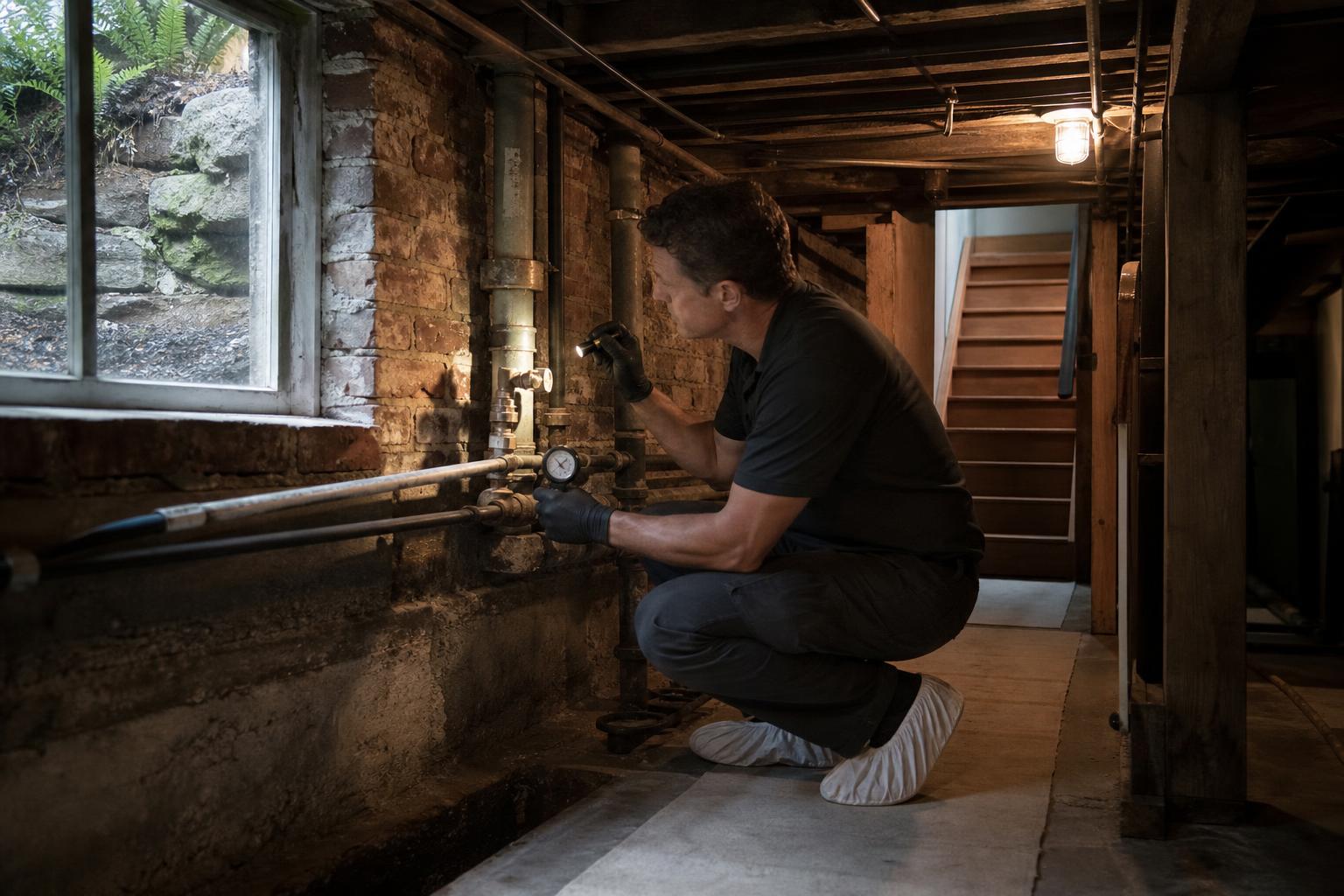
A repipe on Queen Anne is a vertical problem before it is anything else. Three floors of fixtures fed from one original riser means the question is never just which pipe is bad — it’s how far up the failure reaches, and how a new system gets in through plaster and fir without taking the house apart. This page is about that decision. For sewer, drainage and everyday service on the hill, see plumbing service in Queen Anne.
- Typical stock1900s–1920s Victorians, foursquares and craftsman homes, mostly two to three stories
- Common complaintStrong pressure on the main floor, a trickle by the top-floor bath
- Access challengeSteep lots, narrow side yards and original plaster on lath
- How it’s quotedpriced options in writing in writing, approved before any work
Why a three-story Queen Anne house loses pressure upstairs
Upper Queen Anne, the flat hilltop around Galer and Boston, holds the oldest and tallest run of houses: three-story Victorians with a primary bath under the roofline. Every extra foot of rise between the meter and that shower eats more of what little pressure a galvanized line has left, which is why the top floor goes quiet first. That matters for scope, not just comfort. If one branch is the failure point, replacing it buys a year or two; if the scale is uniform from the basement up, the same money spent on the trunk changes every fixture in the house. A meter reading and a floor-by-floor trace separate those two cases.
Old-house note: steep lots and material access
A lot of Queen Anne’s oldest houses sit on a real grade — a narrow side yard, steps down to the basement door, a retaining wall between the street and the crawlspace. Route and material access get planned around that slope first, so getting pipe in and debris out doesn’t become its own project. It’s also a reason two quotes on the same hilltop house can differ by more than the pipe: why repipe quotes differ.
What’s usually behind a Queen Anne wall
Open a wall in a hundred-year-old Queen Anne house and the pipe rarely tells one clean story: original galvanized trunk from the basement, a branch swapped to copper in a 1970s remodel, a length of plastic from a later kitchen update. Every metal transition is a joint, and mixed-metal joints corrode faster than the pipe around them. Add lath-and-plaster and fir floors worth keeping intact and the job becomes a routing question, which is why the route gets traced first and priced second.
Three ways to repipe a Queen Anne house
Not every hilltop house needs the whole system out this year. On a three-story Victorian a repipe usually falls into one of three scopes, each priced as its own written option.
Top-floor pressure fix
Replace the failing branch feeding the upstairs bath without opening the lower floors.
- Camera and pressure trace of the full riser
- Worst branch replaced with copper or PEX
- Honest read on the rest of the system
Trunk and branch repipe
Replace the main riser and the branches to the busiest bathrooms and the kitchen, routed through the existing chase.
- Everything in Good
- Riser sized for three-story pressure
- Mixed-metal joints eliminated
Whole-house repipe
Every galvanized line out top to bottom, one new system labeled at a fresh manifold in the basement.
- Everything in Better
- All three floors repiped
- Permits handled, before-and-after photos
Whichever tier you choose, you approve a written number before I cut into a wall, and it doesn’t move once the job starts. See galvanized pipe replacement for the material, or repipe now or wait for the timing.
The original riser, the scale at each joint, the mixed-metal splice behind the kitchen, and the exact opening planned in the plaster upstairs.
New copper or PEX in the same runs, the pressure test floor by floor, the labeled manifold, and openings left clean for your finisher.
Losing pressure on the top floor? Let’s trace it.
I’ll check the riser, show you what’s behind the wall, and send Good, Better and Best options before any work begins.
More on repiping and on Queen Anne
Repipe cost and process
What drives the number, and what the job looks like day by day.
Repiping in Magnolia
Larger parcels, longer trunk runs, a different pipe era.
Plumbing service in Queen Anne
Everything else on the hill, including the side-sewer question that comes up alongside a repipe.
Questions Queen Anne homeowners ask about repiping
Do I need to repipe the whole house, or just the top floor?
That depends on what the camera and pressure trace show. If one branch feeding the top floor is the failure point, a targeted fix can be the honest answer. If the same corrosion shows at every floor, patching one branch just moves the next leak elsewhere. You get a written option for each path before deciding.
Will you have to open my original plaster walls?
Some openings are unavoidable on a hilltop Victorian, but I route through existing chases wherever the framing allows and plan each one in advance rather than cutting as I go. Canvas runners protect the fir floors and trim, and every opening is photographed before and after.
Is Upper or Lower Queen Anne more likely to need a repipe?
Upper Queen Anne has the highest concentration of 1900s–1920s Victorians and foursquares still on their first supply lines, so it’s where a whole-house repipe is most likely to be the honest answer. Lower Queen Anne mixes that stock with mid-century and newer buildings, so the range runs wider.
Do I need a permit to repipe a Queen Anne house?
Yes. Replacing water supply piping in Seattle generally requires a plumbing permit and an inspection. I pull the permit and schedule the inspection as part of the job, and the record becomes part of the house’s paper trail.