
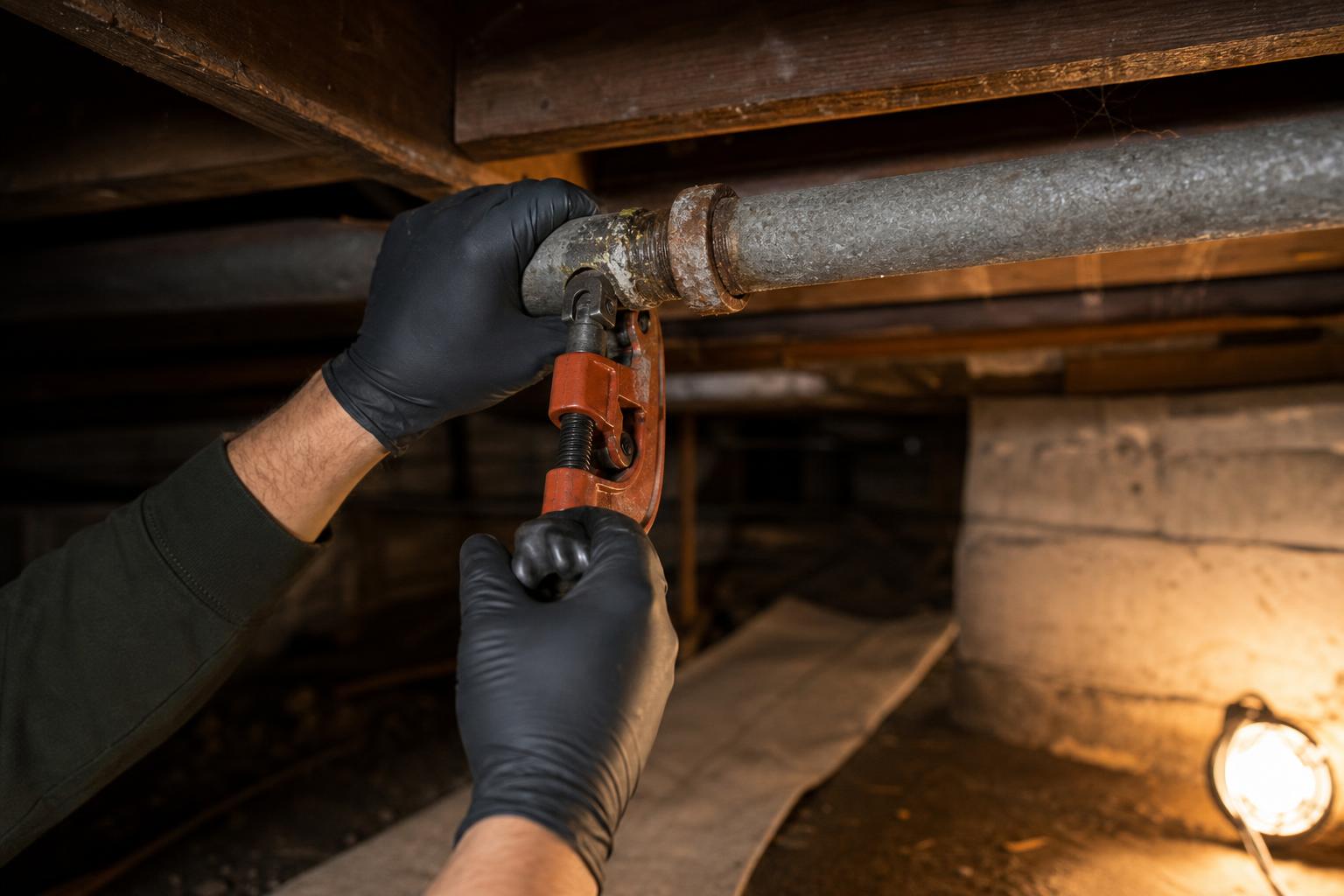
Every Seattle house built before the 1960s that still has its original supply lines is plumbed in galvanized steel, and galvanized steel does not fail all at once. It closes from the inside, one decade of scale at a time, until a shower that used to run strong is down to a trickle and the first glass of water in the morning has a faint rust tint. Nic’s Plumbing replaces galvanized pipe the old-house way: three priced options you approve before we start, and your floors and finishes protected the whole time.
- Typical ageGalvanized steel supply lines were standard in Seattle homes built roughly 1900–1960
- What fails firstThe zinc coating wears through, the steel underneath rusts, and scale narrows the pipe from the inside
- Your optionsTargeted section replacement, partial replacement of the worst runs, or full removal
- How we quoteGood, Better and Best options in writing, approved before any work begins
Signs your galvanized lines are closing up
- A rust tint in the first glass of water in the morning
- A shower that used to run strong and is now down to a trickle
- Pressure that fades the farther the water travels, worst upstairs
- Dull gray threaded pipe visible in the basement or crawlspace
- Corrosion showing at a joint where galvanized meets copper
Why galvanized pipe fails from the inside
This ends in a replacement decision rather than a repair because of how the pipe is built. Galvanized pipe is steel with a zinc coating baked on to keep water from touching bare metal. The zinc does its job for a few decades, then it wears away and the steel starts to rust. That rust does not flush out; it builds up as scale along the inside wall of the pipe, a process plumbers call tuberculation. A line that started at three-quarters of an inch can end up carrying water through an opening the size of a pencil. That is why pressure fades the farther water travels through the house, why the upstairs bathroom is usually worst, and why the first draw in the morning runs brown or rust-tinted: the water sat in a corroded pipe overnight and picked up whatever loosened.
Old-house note: the dielectric union problem
A lot of Seattle homes have been partially updated over the decades, so it’s common to find galvanized steel joined directly to copper wherever the last remodel stopped. Two different metals in contact, with water as the conductor, corrode faster at that exact joint than anywhere else in the run. A dielectric union is a fitting that isolates the two metals from each other, and it stops that reaction. When we replace galvanized, every remaining transition gets one, whether the new material is copper or PEX.
What Nic looks for before quoting
Nothing gets priced from the doorway. The first job is to find out how much of the house is still galvanized and how far the scale has gone, because that is what separates a targeted section replacement from a full removal. That means a camera and a pressure check, a look at the exposed runs in the basement or crawlspace to see where the dull gray threaded pipe stops and newer material starts, and a check of every joint where two metals meet, since those corrode fastest. Only then is there anything honest to put a number on.
Partial replacement or full removal? Both are legitimate answers
Some homes have one bad run feeding the upstairs bath and everything else is holding. Others have galvanized throughout that is uniformly scaled, where a partial fix would just move the next leak down the hall. Once we know what is actually in the walls, we lay out what we found and what each path means for your house.
Targeted section replacement
Replace the specific run causing the problem you called about, restore pressure or stop the leak, and leave the rest of the system for another day.
- Camera and pressure diagnosis of the affected run
- Failing section replaced with copper or PEX
- Dielectric union at every new metal transition
- Honest read on what else is likely aging out
Partial galvanized replacement
Replace the main trunk and the branches feeding your busiest fixtures, leaving genuinely sound newer sections in place.
- Everything in Good
- Trunk and branch lines replaced to kitchen and main baths
- Every mixed-metal joint eliminated
- Openings planned around plaster, trim and fir floors
Full galvanized removal
Every remaining galvanized supply line out, a complete new copper or PEX system in, run to a labeled manifold. The do-it-once answer for a house you plan to keep.
- Everything in Better
- All galvanized removed, including hidden and low-traffic runs
- New labeled shutoffs at a central manifold
- Permits handled, before-and-after photos of every run
Each tier comes back as a written digital quote with its own price and its own scope. You read it, ask questions, and approve one before a single cut is made. That number is the number on the invoice. If you want to weigh a full replacement against copper vs. PEX in more depth first, see PEX vs. copper for a whole-house repipe.
What the photo pair shows on a galvanized replacement
The corroded section cut out and photographed in place: the scale narrowing the bore, the rust at the threads, and — where a past remodel joined metals directly — the pitted joint where corrosion was worst.
The same location with new copper or PEX installed, a dielectric union at every metal transition, the pressure test result, and the opening patched or left clean and square for your finisher.
Partial replacement vs. full removal, side by side
| Consideration | Partial replacement | Full removal |
|---|---|---|
| What it solves | The specific run or runs causing today’s problem | Every galvanized line in the house, at once |
| Disruption | Limited to the sections being opened | Whole-house, planned around your schedule |
| Best fit | Newer partial updates already in place, one bad run identified | Uniform corrosion across the system, or a house you plan to keep long-term |
| What’s left behind | Some galvanized remains, monitored going forward | Nothing galvanized left to fail later |
| Photo documentation | Before-and-after of the runs replaced | Before-and-after of every run, plus a labeled manifold map |
Rusty water or fading pressure? Let’s look before you decide anything.
We’ll trace what’s actually galvanized in your house, explain it plainly, and send Good, Better and Best options to approve before any work begins.
Galvanized replacement in Seattle’s historic neighborhoods
Galvanized pipe is common wherever Seattle’s oldest housing stock stands. Each of these pages covers the plumbing common to that neighborhood’s homes and how a whole-house repipe usually goes there.
Repiping in Queen Anne
Victorian and foursquare homes on the hill, often with three floors of pressure problems.
Repiping in Magnolia
Mid-century and earlier homes with long supply runs and finished basements to protect.
Repiping in Ballard
Bungalows with tight crawlspaces and decades of partial updates joined together.
Not sure how far the corrosion runs, or want the full-house picture first? Galvanized turns up just as reliably in Fremont’s early cottages. Start with whole-house repiping or see what drives the price in our repipe cost guide.
Questions homeowners ask about galvanized pipe replacement
How do I know if my pipes are actually galvanized?
Look at an exposed section in the basement or crawlspace: a dull gray pipe with visible threaded joints, often magnetic, sometimes rust-streaked at the fittings. Copper is reddish and smooth; PEX is flexible plastic. If you’re not sure what’s under your sinks, our guide to how to tell if you have galvanized pipes walks through what to look for.
Can I replace just the worst section, or do I need a full repipe?
Often, yes. If a camera and pressure check show the rest of the system is holding, a targeted replacement fixes the immediate problem for a fraction of a full repipe. If corrosion is uniform across the house, patching one run usually just relocates the next leak, and we’ll say so instead of quoting a fix we don’t believe in.
What’s a dielectric union and why does it matter?
It’s a fitting that keeps two different metals, say galvanized steel and copper, from touching each other through the water. Without one, that joint corrodes faster than the rest of the pipe, which is a common reason a single fitting fails years before the surrounding line does. We install one at every metal transition, new or existing.
How long does galvanized pipe actually last?
There’s no single number. It depends on water chemistry, how the pipe was installed, and what’s around it. What we can tell you honestly is that galvanized in a Seattle home this old is well past the zinc coating’s useful life, which is why the symptoms show up as rust and shrinking pressure rather than a sudden failure.
Will replacing galvanized pipe fix my low water pressure?
If the pressure loss is from scale narrowing the inside of galvanized pipe, which is the usual case in older Seattle homes, yes — new full-bore lines restore the flow the fixtures were designed for. If the real cause is a failing pressure-reducing valve or a utility-side issue, our diagnosis will show that instead, and we won’t sell you a replacement you don’t need.
Do I need a permit to replace galvanized pipe in Seattle?
Replacing water supply piping generally requires a plumbing permit and inspection in Seattle, whether it’s one section or the whole house. We handle the permit and schedule the inspection as part of the job, so ask us about the specifics for your project when we scope it.