“Trenchless” gets used as one word online, but it is really two different repairs. Pipe lining cures a new pipe inside the old one; pipe bursting pulls a brand-new pipe through the old one’s path while breaking it apart as it goes. Both can save your driveway, your rockery and your mature trees from a full excavation, and both only work under the right conditions. Nic’s Plumbing runs the camera first, tells you honestly which method your line qualifies for, and prices it as Good, Better and Best before anyone digs a pit.
- Pipe lining (CIPP)A resin-saturated liner is inverted or pulled through the old pipe and cured in place, one access point
- Pipe burstingA new HDPE pipe is pulled through the old pipe’s path from two small pits, breaking the old pipe outward
- What decidesThe condition of the host pipe on camera, not a guess from the driveway
- How we quoteCamera inspection first, then Good / Better / Best digital pricing approved before work starts
“Will that resin actually last?” The questions we hear before anyone digs
People land on this page with a quote already in hand and a knot in their stomach. One company said lining, another said bursting, the numbers were nowhere close, and nobody showed the footage that would explain the difference. That is a fair thing to be stressed about. A liner and a burst pipe solve different problems, and a contractor who quotes one without watching the camera first is guessing.
Both methods depend on the same thing: what shape the old pipe is in right now. A line with root-cracked joints and hairline fractures that still holds its original round shape is a lining candidate. A line that is crushed, badly out of round, or made of a material like Orangeburg that has already started to flatten is not; it needs to come out, and bursting or an open trench is how that happens without tearing up the whole yard.
What each method actually needs
Pipe lining: one access point, a pipe that still holds its shape
We hydro-jet the line clean of roots and scale, camera it again to confirm the shape and diameter, then invert or pull the resin-saturated liner in from the existing cleanout or a single small opening. The liner cures against the inside wall of the old pipe, sealing every joint and crack along the way, and we camera the cured liner before we sign off. Because the host pipe stays in place as a form, lining cannot fix a belly, a collapse, or a section that has lost its round shape; it can only follow what is already there.
Pipe bursting: two small pits, a genuinely new pipe
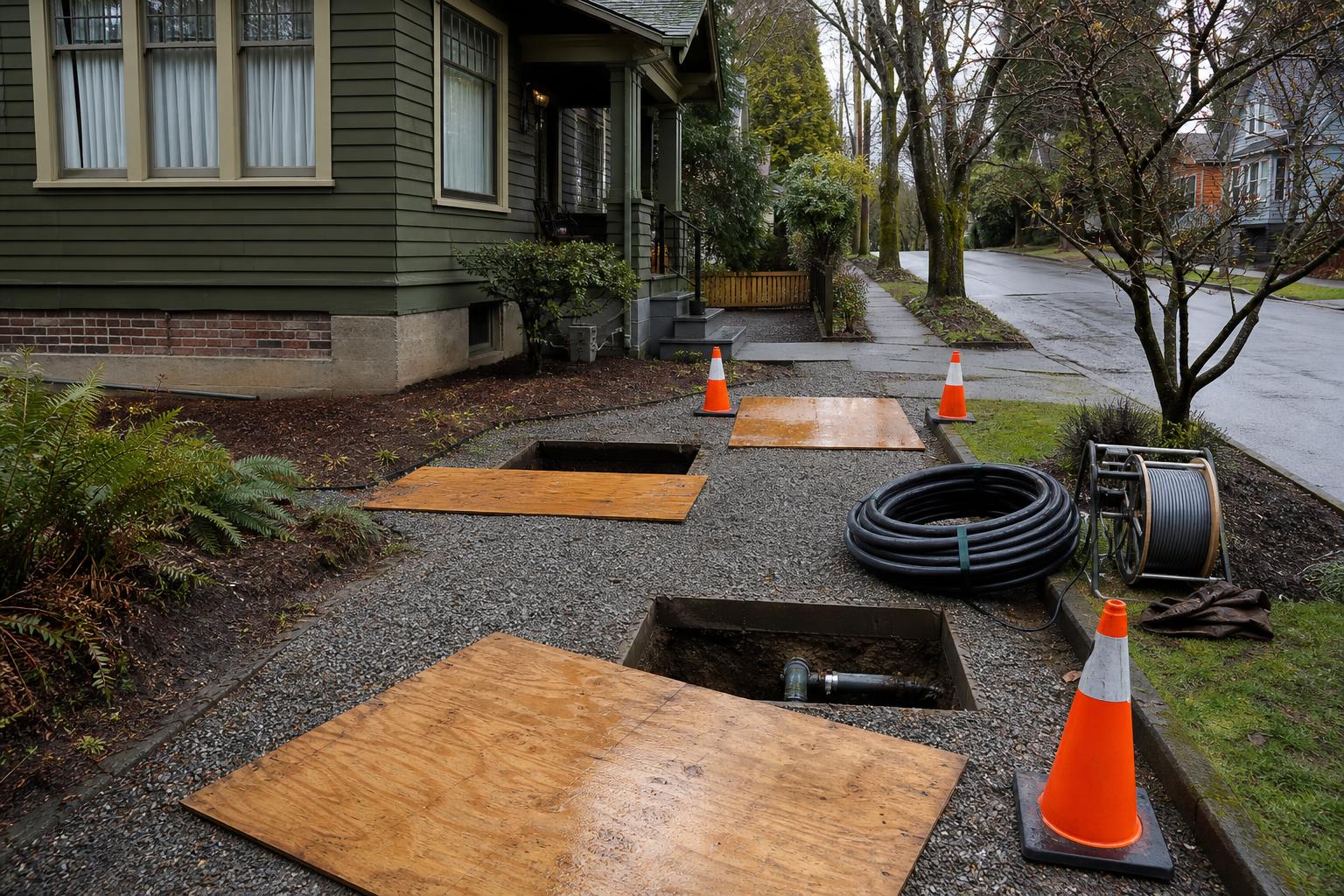
Bursting needs a launch pit near the house and a receiving pit near the main, usually a few feet across each, not a trench along the whole run. A bursting head is winched through the old pipe, fracturing it outward into the surrounding soil while a new HDPE pipe is pulled in directly behind it. Because the old pipe is being replaced rather than lined, bursting can hold its own against a badly cracked or partially collapsed line, and it can upsize the pipe where the house needs more capacity, something a liner cannot do.
Either way, the pits and any interior access point get canvas runners, plywood over lawns and beds, and the smallest opening the method allows. If the pits reach the planking strip, sidewalk or street, that work needs an SDOT Street Use permit, which we request from within the same Seattle Public Utilities Side Sewer Permit application; we handle that filing as part of the job.
When we will tell you to dig instead
Trenchless is not always available, and we say so plainly when the camera rules it out. A fully collapsed section, a deep belly where the pipe has sagged and holds standing water, or an offset joint bad enough that the pipe is no longer a continuous path all point to an open trench. A trench is also how we correct grade, which no trenchless method can do, since both lining and bursting follow the slope that is already there. If your line falls into any of those, we would rather quote the trench honestly than sell you a liner that will fail. Our trenchless vs. dig-and-replace guide goes deeper on that decision.
Spot lining or spot repair
A single root-cracked joint or short damaged section in an otherwise sound line, sealed with a sectional liner or a small targeted dig.
- Full camera run and locate before any work
- Hydro-jet and prep of the affected section
- Camera-verified result before backfill
- Plain note on the rest of the line’s condition
Full-length CIPP lining
The whole run relined from one access point where the host pipe holds its shape end to end, sealing every joint at once.
- Everything in Good
- Full hydro-jet and prep of the entire line
- Full-length resin liner, cured and camera-verified
- Lateral connections reinstated where the liner crosses them
Pipe bursting: full replacement
A genuinely new HDPE pipe from house to main, pulled through the old pipe’s path from two small pits, upsized if your house needs it.
- Everything in Better where applicable
- New HDPE line, house to main, properly connected
- Line can be upsized where capacity is the issue
- Permits, inspection and pit restoration handled
We do not default to “Best” to make the bigger sale. If your footage shows a sound pipe with a couple of open joints, a lining tier is the honest, permanent answer and we will say that in writing. See how the free Good / Better / Best quote works before you decide anything.
Lining vs. bursting, side by side
| Consideration | Pipe lining (CIPP) | Pipe bursting |
|---|---|---|
| Requires | Host pipe still round, structurally sound enough to line | A clear-enough path from house to main; two access pits |
| Digging | Usually none beyond the existing cleanout | Two small pits, typically a few feet across each |
| Fixes a belly, collapse or bad offset | No; the liner follows the old pipe’s exact shape | No; the new pipe follows the old pipe’s path and grade |
| Pipe size after the job | Slightly smaller inside diameter | Same size, or upsized if the house needs more capacity |
| Best fit for | Root-cracked joints, hairline fractures, minor infiltration | Badly cracked, partially collapsed or undersized pipe |
| Typical time on site | Often a single day | Often one to two days |
| Yard and landscaping impact | Minimal; existing openings only | Two pit locations; everything between them undisturbed |
What the camera footage shows on a lining or bursting job
The full inspection run with distance markers, showing exactly which joints are open, where root intrusion sits, and whether the pipe is still round enough to line or needs to come out.
A second camera pass through the cured liner or the new HDPE line, plus photos of the access point or pits restored, so the finished job is documented, not just described.
Not sure which one your line needs? Let’s put a camera in it.
We will show you the footage, explain honestly whether lining, bursting or a trench is the right call, and send priced Good, Better and Best options before anything is scheduled.
Go deeper on side sewers
Main sewer line & trenchless repair
The full picture on side sewers: camera inspection, permits, and how we choose between spot repair, lining and replacement.
Sewer camera inspection
How the scope works, what it reveals in a pre-1960 home, and why it comes before any lining or bursting quote.
Trenchless vs. dig-and-replace
When an open trench is honestly the better choice, and what it can fix that no trenchless method can.
Questions homeowners ask about lining and bursting
How do you decide between lining and bursting for my line?
The camera decides, not a guess from the yard. If the pipe still holds its round shape and the damage is joints and cracks, lining is usually the right, less invasive fix. If the pipe is badly broken, partially collapsed, or needs to be larger than it is, bursting replaces it outright. We show you the footage so the reasoning is visible, not just the recommendation.
Will a liner really last as long as new pipe?
A properly cured liner is a structural pipe in its own right, not a coating, and it is designed for decades of service once it is installed correctly on a suitable host pipe. That “if installed correctly on a suitable host pipe” is the whole point of the camera check beforehand and the camera-verified cure afterward. A liner put into a pipe that was never a good candidate is what leads to the horror stories; we will not quote one where the pipe doesn’t qualify.
Does pipe bursting really dig up my whole yard?
No. Bursting needs two small pits, one near the house and one near the main, not a trench between them. The ground between the pits is undisturbed because the new pipe is pulled through the path the old pipe already occupied. It is far less invasive than an open-trench replacement, though not quite as minimal as lining, which usually needs no digging at all.
Can lining or bursting fix a belly or a collapsed pipe?
No, and we will tell you that up front instead of after the fact. Both methods follow the exact shape and slope of the existing pipe; neither can correct grade or hold its own where the old pipe has already caved in. A belly, a collapse or a badly offset joint means an open trench, which is the only method that lets us reset the slope. Our trenchless vs. dig-and-replace guide walks through the difference.
Do lining and bursting need a permit in Seattle?
Yes. Seattle Public Utilities requires a Side Sewer Permit for any side sewer repair or replacement, lining and bursting included, whether the work stays on your property or reaches the right-of-way. If a pit or access point lands in the planking strip, sidewalk or street, an SDOT Street Use permit is added through the same application. We file both and schedule the inspection as part of the job.
Can bursting make my sewer line bigger?
Yes, within reason. Because bursting pulls an entirely new pipe through, it can size that pipe up from what was there before, which matters for a house that has added bathrooms or fixtures since the original line went in. Lining cannot do this; the liner sits inside the existing diameter and leaves the pipe slightly smaller than it was.