
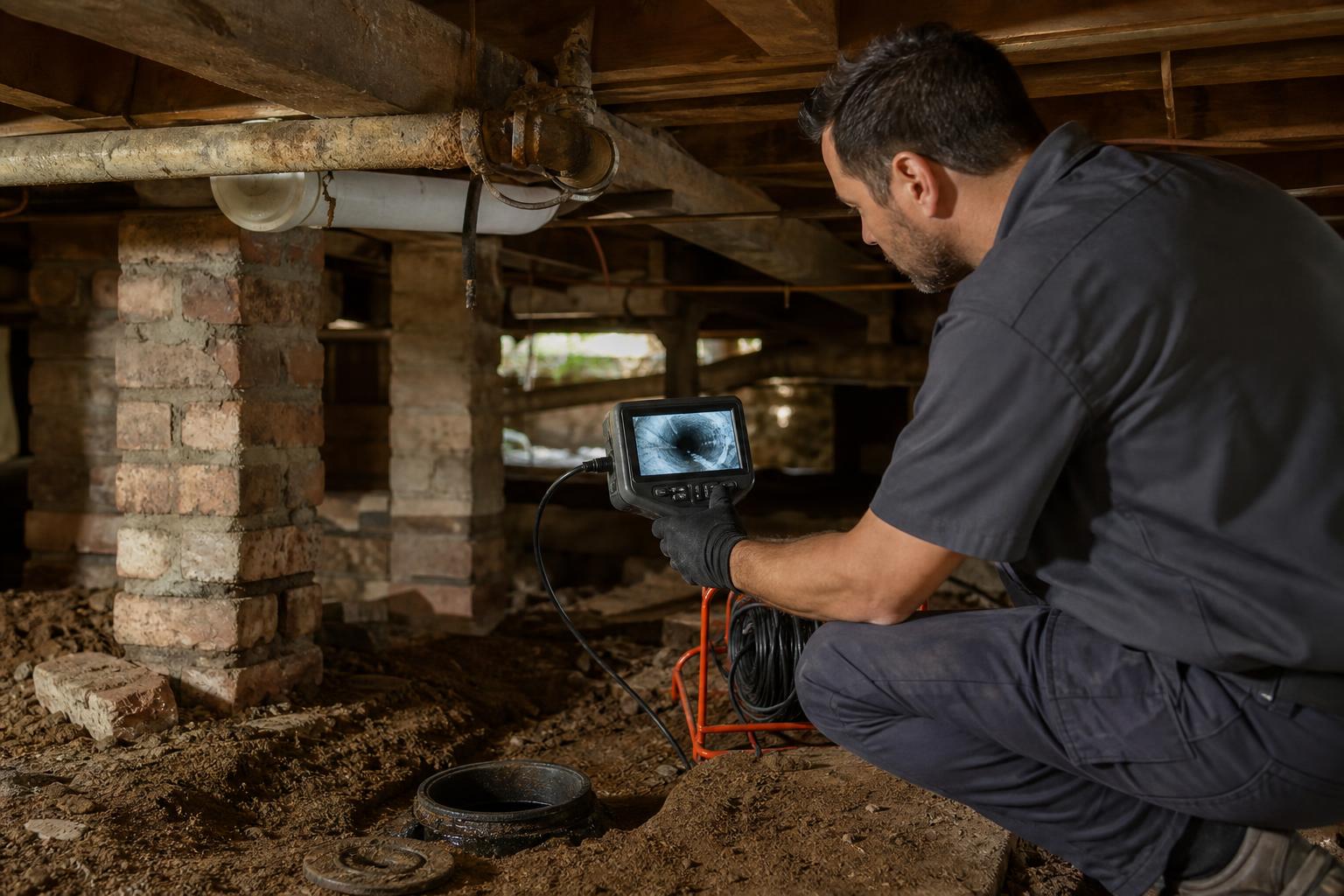
A sewer camera inspection is the only way to see what’s actually happening inside your side sewer instead of guessing from what backs up in the yard. We feed a waterproof camera down the line from a cleanout and walk it to the city main, recording roots, cracks, offset joints and a bellied section holding water. You get the footage and a plain-language read of what it means.
- What it findsRoot intrusion, cracks, offset joints, bellies and the pipe material itself
- Typical run timeA residential line usually takes 30–60 minutes, depending on length and access
- Common in SeattleHomes with mature street trees and clay, cast iron, or Orangeburg side sewers
- You getThe full recording, a marked problem spot, and a plain read of what it means
Signs it is worth scoping the line
- Slow drains at more than one fixture rather than at a single sink
- A soggy patch of yard that will not dry out
- A line that gets rodded on a schedule instead of after a problem
- Mature street trees over a clay, cast iron or Orangeburg lateral
- A pre-1970s house under offer, where the buried run is the biggest unknown in the deal
What a sewer camera actually shows
The camera has its own light and travels the pipe from the inside, so we are looking directly at the problem, not interpreting a symptom. Roots show as hairy fibers reaching through a joint or crack. A crack is a dark line running with or across the pipe. An offset joint is a visible step where one section no longer lines up with the next, usually from ground settling. A belly is a low spot where the pipe has sagged, visible as standing water even when nothing is running. Older Seattle homes also turn up Orangeburg pipe, a tar-paper-based material used roughly 1940s–1970s that softens and goes oval with age. None of this is a guess once it is on camera.
Old-house note: mature trees and older sewer materials
Seattle’s older neighborhoods pair century-old street trees with clay, cast iron, and Orangeburg side sewers laid before anyone thought about root pressure. Roots follow the smallest crack toward the moisture inside, widening it every year. A camera inspection tells you which stage you’re at: roots to monitor, or a joint too far gone to hold. Our Seattle side sewer guide covers ownership and permitting basics too.
Why homeowners call for a scope
There are usually two reasons to scope a line: a symptom, like slow drains at multiple fixtures or a soggy yard patch that won’t dry out, or a real estate deadline, where a buyer wants to know what they’re actually buying before an old sewer becomes their problem. Both share the same anxiety: not knowing what’s wrong before someone hands you a number. A scope removes the guesswork, and any recommendation we make points back to a specific frame in the footage.
Sewer scopes for pre-purchase inspections on historic homes
A general home inspector checks the visible plumbing, not the buried pipe between house and street. On a home built before the 1970s, that buried run is often the single biggest unknown in the deal. In Seattle, the side sewer belongs to the homeowner to the city main, so a buyer inheriting a bad line inherits the whole repair. We record the full run and give you a plain read, something to bring to negotiations or move forward with confidence. The city keeps a side sewer card for most older lots showing the pipe’s original layout, and our Seattle side sewer guide explains how to find and read it. We use it alongside the footage.
How the inspection goes
Find or create access
We use an existing cleanout, or discuss the best alternate access before starting.
Run the camera
The camera travels the full line, with a footage counter marking distance.
Narrate and record
We talk through what the camera shows, and the full run is recorded.
Mark and locate
Any defect gets a marked footage distance, plus a locate on the Best tier.
Explain it plainly
You get the footage plus a plain read on urgency and options.
What an inspection can include
- The scope itself. A full-length camera run from an existing cleanout, with a live walkthrough of what the camera shows and a plain summary of the line’s condition.
- The recording and written notes. The full video handed to you, plus written notes on any defect and the footage distance where it sits, so you can keep it or share it with an inspector.
- An above-ground locate. The pipe path and any problem spot marked on the ground, compared against the side sewer card on record where one exists. This is the one worth having if you are buying the house or planning a repair.
You’ll see the price and approve the work before I start. See how that works on our free quote page.
Reading a scope: what each finding usually means
| What the camera shows | What it usually means | Typical urgency |
|---|---|---|
| Root hairs at a joint | Early intrusion through a small crack or gap | Monitor or clear |
| Dense root mass | Years of growth restricting flow | Address soon |
| A visible crack | The pipe wall has failed at that point | Depends on size and leak |
| An offset joint | Ground movement shifted one section out of line | Worth watching |
| A belly (standing water) | The pipe has sagged and no longer drains fully | Depends on depth |
| Oval, softened Orangeburg | The pipe material is breaking down with age | Plan for replacement |
If a scope turns up something that needs fixing, the footage becomes the starting point, not a reason to start over. See how we compare trenchless lining versus pipe bursting for what each defect typically calls for.
What the recording proves
The full camera run with a footage counter, showing exactly how far into the line any defect sits.
A recording you keep, with any problem spot marked, so a second opinion works from the same evidence, not a fresh guess.
Slow drains, a backup, or a home you’re about to buy?
We’ll run the camera, show you exactly what’s in the line, and explain it in plain language before you decide anything.
More on sewer lines and repair options
Side sewer repair and replacement
Repair options once a scope shows what’s going on in your line.
Pipe lining vs. pipe bursting
Two trenchless methods compared, and what each can and can’t fix.
Seattle side sewer guide
Who owns what, when a permit applies, and how to read a side sewer card.
Trenchless vs. dig-and-replace
How the two approaches compare on disruption, timeline and scope.
Camera inspections are available across our full service area. For the neighborhood picture, start with plumbing in Queen Anne, Ballard or Wallingford, or see all service areas.
Questions homeowners ask about sewer camera inspections
Do I need a cleanout for a camera inspection?
It helps but isn’t required. Many older homes don’t have one, in which case we can often run the camera through a roof vent or by pulling a toilet. We’ll tell you the best access point before scheduling.
How long does a sewer camera inspection take?
Most residential lines take 30 to 60 minutes, depending on length and access. Add time if we’re locating a problem spot above ground on the Best tier. We’ll give a realistic window when we schedule.
Can a camera inspection tell me if I need to replace the whole sewer or just part of it?
Usually, yes. The footage shows where a problem starts and ends, which determines whether a spot repair or full-line work makes sense. We mark the location of anything we find and walk you through each option.
Is a sewer scope worth it before buying an older Seattle home?
For homes built before the 1970s, we think so. The side sewer is the one major system a standard home inspection can’t see, and in Seattle it belongs to the buyer the moment they close, to the city main. A scope turns an unknown into something you can plan for.