
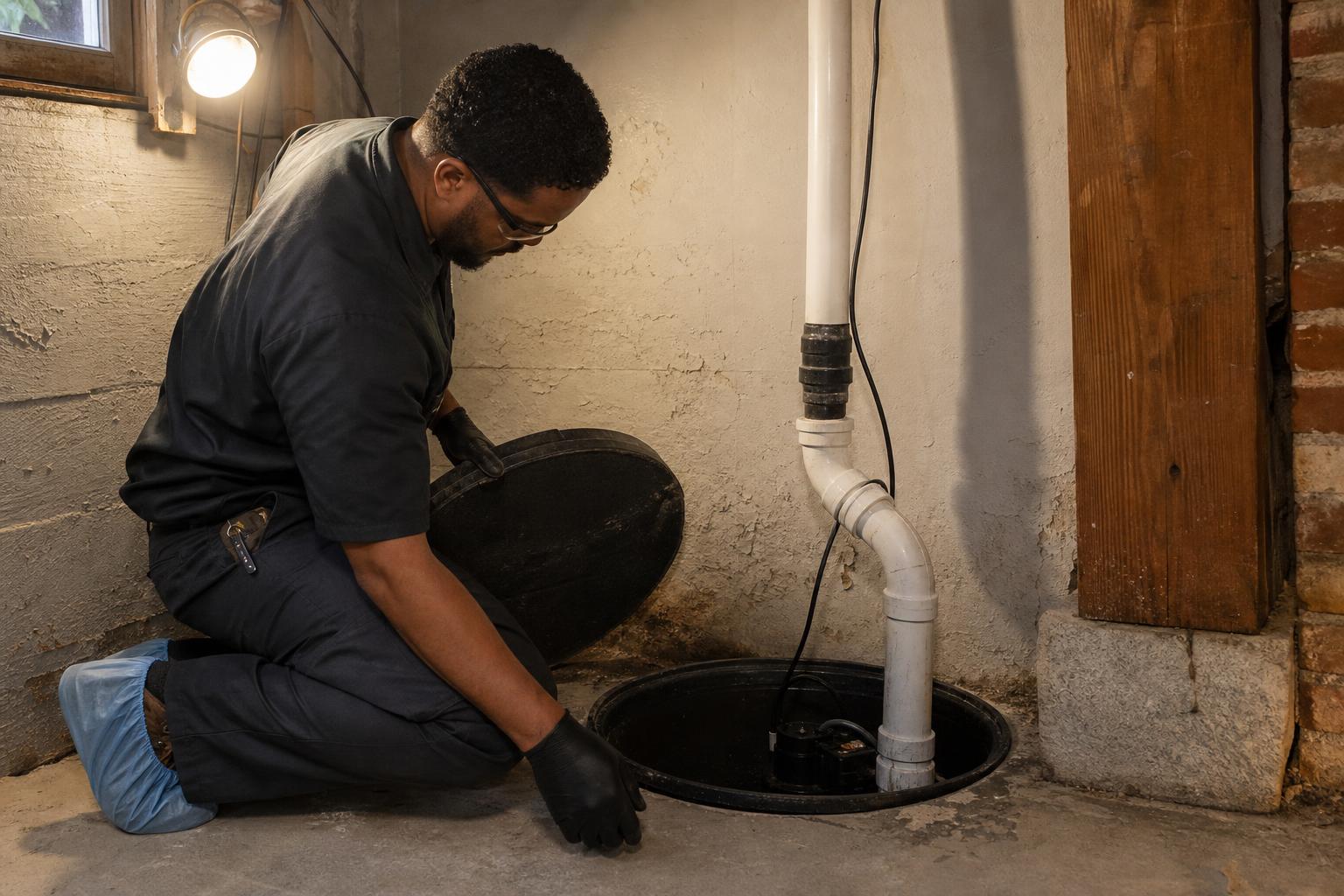
A sump pump and a backwater valve solve two different problems, and most flooded Seattle basements only get told about one of them. A sump pump moves groundwater out from under the house. A backwater valve stops the side sewer from pushing water back in. Older basements often need both, and the honest first step is figuring out which kind of water you actually have.
- Sump pump answersGroundwater and hydrostatic pressure pushing in from below or through the wall
- Backwater valve answersA combined or surcharging side sewer pushing back up through the floor drain
- Often bothOlder basements in low-lying or combined-sewer blocks commonly need the pair
- How we quoteA drainage walk-through, then Good, Better and Best options you approve first
When each one is the answer
People tell us they didn’t know what a sump pump was until they saw water pooling downstairs, and that they nodded along on the first visit because they didn’t want to admit they had no idea what they were looking at. Here’s the plain version. A sump pump lives in a pit at the low point of the floor and switches on when groundwater collects there, sending it outside through a discharge line. A backwater valve sits in the side sewer and stays open for normal drainage, then closes if water tries to flow backward from the street. One deals with water getting in from the ground; the other deals with water coming back up the pipe you already have.
The clue is usually in how the water arrives. Clear water seeping in at the base of a foundation wall during or right after a storm is groundwater — a sump pump problem. Water rising out of the floor drain, especially with a sewage smell, means the sewer itself is backing up — a backwater valve problem. Homes in Ballard, Fremont, Wallingford and the northern part of Queen Anne sit on a combined sewer, where storm water and sewage share one pipe to the West Point Treatment Plant. In a heavy storm that shared line can fill faster than it drains, and a basement floor drain is often the lowest opening it finds on the way back out.
Old-basement note: the pit that was never sized for the house
A recurring story we hear is a sump pump that runs constantly during a storm and still loses the race — “the pit and pump is undersized,” as one homeowner put it. Older basements often have whatever pit and pump a previous owner installed decades ago, sized for a smaller storm than Seattle now sees. We check the pit size, the pump’s capacity, and how much water is actually arriving, because swapping in the same undersized pit just repeats the problem.
What we install, and why battery backup matters
A sump system is a pit, a submersible pump sized to what your foundation actually sees, a check valve so water doesn’t drain back into the pit between cycles, a discharge line routed well clear of the house, and a high-water alarm. The part people skip, and regret, is battery backup. Seattle storms that flood basements are the same storms that knock out power, and a pump with no backup stops at the worst possible moment. A backup sized to the pump keeps it running through the outage.
A backwater valve installs in the side sewer, usually near a cleanout or just inside the foundation, and needs an annual check to confirm it still closes fully — a valve rusted open protects nothing. Installing one generally involves a permit, which we handle. Whether your house is a candidate depends on where your lowest fixture sits relative to the street and whether your block is on a combined sewer; we’ll tell you plainly rather than assume every old basement needs one.
Sump pump, right-sized
For basements taking clear groundwater and nothing else. A pit and pump matched to what your foundation actually sees, not a swap of the same undersized setup.
- Pit and submersible pump sized to the house
- Check valve and a high-water alarm
- Discharge line routed away from the foundation
- Honest read on whether a backwater valve applies too
Sump pump plus backwater valve
For basements that take water from the ground and from the floor drain — the common case in combined-sewer neighborhoods.
- Everything in Good
- Backwater valve on the side sewer, permit included
- Annual-check reminder built into the job
- Both systems tested under load before we leave
Storm-ready, with backup
For finished basements and homes you want protected through a power outage, not just a heavy rain.
- Everything in Better
- Battery backup sized to the pump
- High-water alarm tied to a phone alert
- Discharge and drainage reviewed as one system, not two
Every tier arrives as a written quote you approve before we touch anything. If a full system is more than your basement needs, we’ll say so. See how the free Good / Better / Best quote works.
Sump pump or backwater valve — what stops what
| System | Stops | Doesn’t stop |
|---|---|---|
| Sump pump | Groundwater rising through the floor or seeping at the foundation wall | A sewer backing up through the floor drain |
| Backwater valve | Sewage or storm water pushed back up the side sewer during a surcharge | Groundwater coming in from the surrounding soil |
| Battery backup | The pump quitting when the power goes out mid-storm | A pit or pump that was already undersized |
The old pit and pump as found, the water line on the wall, the floor drain with no valve, and the discharge line dumping back at the foundation.
The new pit, pump and alarm tested, the backwater valve and its access cover, the discharge routed clear of the house, and the test result.
Basement taking water before the storms start? Let’s look before it’s an emergency.
We’ll walk the water path, tell you plainly whether you need a pump, a valve, or both, and send Good, Better and Best options to approve before any work begins.
Combined-sewer basements by neighborhood
Whether a backwater valve makes sense often comes down to which sewer basin your block sits in. These neighborhoods carry the combined sewer where sewage and storm water share one pipe to West Point.
Ballard
Combined sewer basin, bungalow crawlspaces, and floor drains that back up in the first big storm.
Fremont
Low-lying streets near the canal and early cottages with tile footing drains.
Wallingford
Craftsman homes on the combined sewer, with basements that were never meant to be bedrooms.
Queen Anne
The north slope sits on the combined sewer; hillside run-off adds to the load in a heavy rain.
Not sure which basin you’re in? Start with heavy-rain drainage and storm protection, or if the side sewer line itself may be damaged, see main sewer line and trenchless repair.
Questions homeowners ask about sump pumps and backwater valves
Do I need a sump pump, a backwater valve, or both?
It depends where the water comes from. Clear water at the wall or floor joint during rain is groundwater, a sump pump job. Water rising out of the floor drain, especially with a sewage smell, is the sewer backing up, a backwater valve job. Combined-sewer neighborhoods often see both, so we check before recommending either one.
Is a backwater valve required in Seattle?
Plumbing code may require one where your lowest fixture or floor drain sits below the next upstream manhole, and installing one generally involves a permit. We’re not aware of a blanket mandate for every Seattle home, so we check your specific situation and tell you plainly whether your house is a candidate rather than assume.
How does a backwater valve actually stop a sewer backup?
It sits in the side sewer with a flap or gate that stays open for normal flow going out. If water tries to reverse direction — because the public main or a shared combined line is surcharging — the flap closes and blocks it before it reaches your fixtures. It needs an annual check, because a valve stuck or rusted open isn’t protecting anything.
Why does battery backup matter for a sump pump?
The storms that flood Seattle basements often knock out power too. A sump pump with no backup shuts off exactly when you need it most, and a basement can take on hours of water before anyone notices in the middle of a storm-night outage. A battery backup sized to your pump keeps it running through it.
My sump pump runs constantly in a storm and the basement still takes water — why?
Usually the pit or the pump is undersized for what’s actually arriving, a common story in older homes with whatever equipment a previous owner installed. Swapping in an identical pump just repeats the problem. We size the pit and pump to your soil, grading and roof area, not to what was already there.
Will installing a sump pit or backwater valve tear up my basement floor?
Both require an opening in the slab or floor, but we keep the cut as small as the job allows, lay runners over the rest of the finished floor, and photograph the opening before and after. Most homes only need one or two openings total, and we plan the location with you before any concrete comes up.