South Lake Union is Seattle’s newest-built neighborhood by a wide margin: mid-rise and high-rise condo towers, apartments, and a scatter of early-1900s brick warehouses converted to loft-style living around the edges near Westlake Avenue North and the lake itself. Most of the plumbing here is younger than the plumbing anywhere else on our map, but “newer” doesn’t mean “no problems.” It means a different set of problems, in-unit water heaters, shared risers, HOA sign-off, and Nic’s Plumbing plans every South Lake Union visit around that.
- ZIP code98109 (South Lake Union, shares the ZIP with Queen Anne to the west)
- Housing eraMostly 2000s–2020s condo and apartment towers, plus a handful of early-1900s brick buildings converted to lofts
- Most common callsIn-unit water heater swaps, fixture repair, and shared-riser leak tracing
- How work gets approvedGood / Better / Best digital pricing, plus building or HOA coordination where a job needs it
What South Lake Union’s buildings are dealing with
Walk from Westlake Avenue North toward the lake and most of what you see went up after 2005: glass-and-steel towers with underground parking and units plumbed in modern copper or PEX rather than the galvanized steel we deal with in Queen Anne or Ballard. That’s good news for supply-line corrosion. What it doesn’t solve is the layout problem of stacked housing: your water heater lives in a closet, not a basement, your supply and drain lines run through a shared riser that also serves the unit above and below you, and a leak rarely stays contained to one address. A handful of older brick buildings near the neighborhood’s industrial edge, converted from warehouses into loft condos, add another wrinkle: original cast-iron drain stacks now carrying residential loads they weren’t built for.
South Lake Union homeowners tell us the same thing homeowners tell us everywhere: they don’t know what they’re looking at when a tech shows up with an iPad and a number, and they want a sanity check before they approve anything. In a building, that worry gets an extra layer, because you’re also trying to figure out what’s your responsibility and what belongs to the HOA or property management. We sort that out before we quote, not after.
Building note: shared risers and HOA coordination
In a condo or apartment building, your unit’s supply and drain lines usually tie into a shared riser that runs through several floors. A leak that shows up in your ceiling may be coming from the unit above, and a repair inside a wall may need building access or a brief water shut-off that affects your neighbors. We ask who manages the building before we schedule anything, and we bring whatever documentation your HOA or property manager needs for access.
The services we run most often in South Lake Union
Water heater installation and swaps
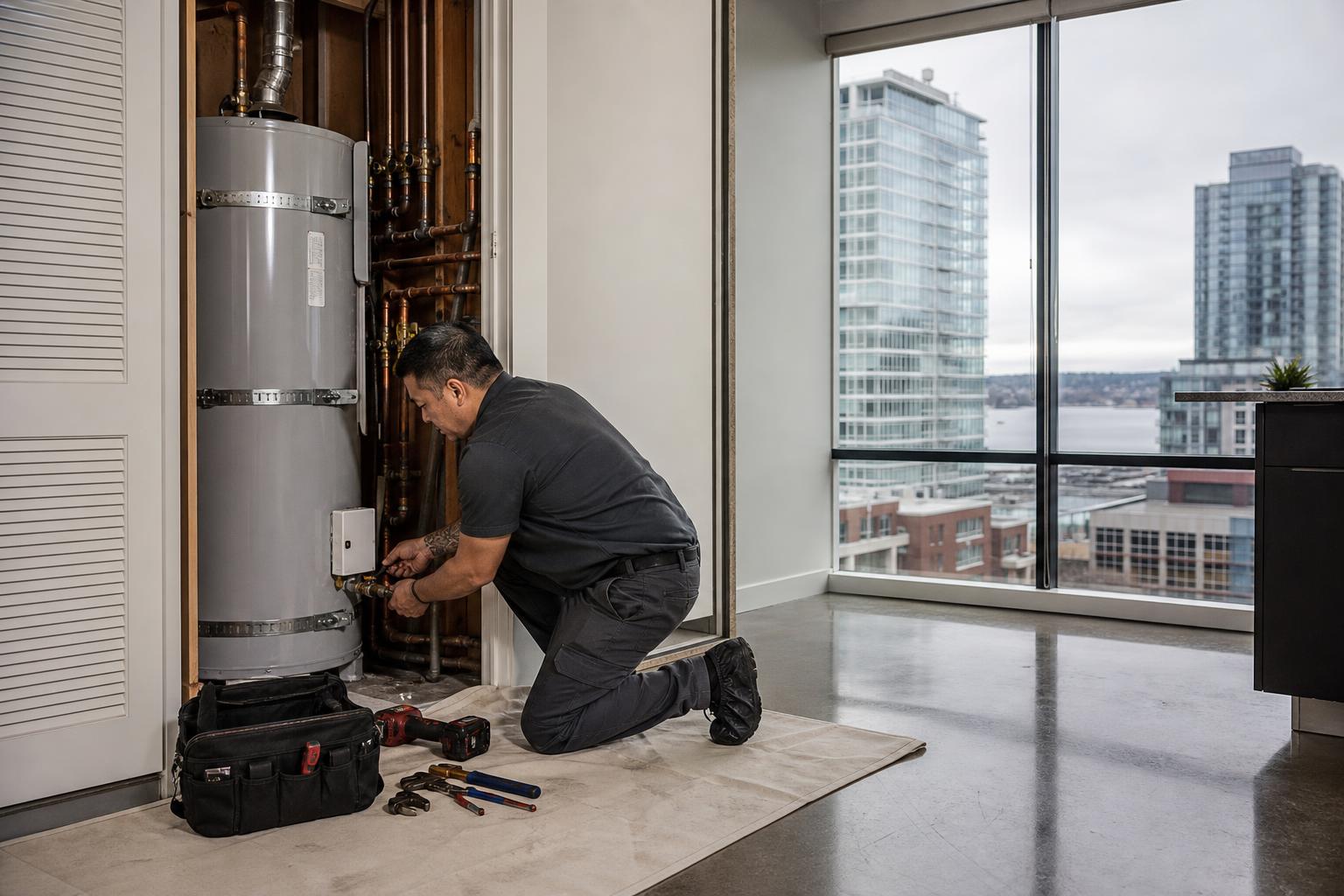
In-unit tank water heaters in a utility closet are the single most common job here. Closet dimensions, venting, and gas or electric supply all shape which replacement actually fits. See water heater installation and efficiency upgrades.
Standard service calls and fixture repair
Faucets, toilets, garbage disposals, and in-unit leaks are routine work in a building this size and this new. See standard service calls and fixture repair.
Side sewer and shared-line diagnosis
Older brick loft conversions can still have original cast-iron stacks now serving multiple units, and a clog two floors up can look identical to a clog in your own line. See main sewer line and trenchless repair.
Whole-house repiping and heavy-rain drainage support come up less often in a new-construction tower, but they’re part of the same map for the older brick buildings and the ground-floor commercial spaces around the neighborhood’s edges. See old-home pipe mitigation and repiping or heavy-rain drainage support if either applies to your building.
Replacing an in-unit water heater: your three options
A failing water heater in a condo closet isn’t a one-size question. What fits depends on the closet, the venting already in place, and how long you plan to stay. We look first, then lay out what each option actually means for your unit.
Like-for-like tank swap
Replace the failing tank with a comparable unit in the same footprint, using the existing venting, gas or electric connection, and drain pan.
- Same closet, same connections, minimal disruption
- New shutoffs and a fresh expansion tank where code calls for it
- Fastest path back to hot water
Higher-efficiency tank upgrade
Step up to a higher-efficiency tank model sized correctly for your unit, with code items addressed as part of the install.
- Everything in Good
- Efficiency-rated tank matched to your household size
- Seismic strapping and expansion tank brought current
Tankless conversion
Where the closet, gas line, and venting support it, a tankless unit frees up closet space and delivers continuous hot water.
- Everything in Better
- Compact wall-mounted unit, more usable closet space
- We’ll tell you plainly if your unit isn’t a good candidate
Each option arrives as a written digital quote before we touch anything, so you approve the number, not a surprise on the invoice. Curious about tankless versus tank in general? See tankless vs. tank water heaters.
How a visit works in your building
Building access is the first thing we plan around, not an afterthought. We confirm whether your building needs a certificate of insurance on file, a service-elevator reservation, or a lobby check-in, and we send a live tracking link when the tech is on the way so you know when to buzz them up. Tech en route · live map Inside the unit, a canvas floor runner goes down before anyone crosses your floors, whether that’s engineered hardwood or polished concrete, and the tech traces what your unit actually has before recommending anything. You get Good, Better and Best options in writing, and you approve one before work starts.
Photos of the water heater or fixture in question, the closet or riser access point, and the shutoff we’ll use during the repair.
The same spot with the new unit or repair in place, labeled shutoffs, and the workspace sanitized before we leave.
Water heater on the way out, or a leak you can’t place?
We’ll trace what your unit actually has, coordinate with your building if needed, and send Good, Better and Best options to approve before any work begins.
More on the services South Lake Union calls for most
Water heater installation
Tank swaps, efficiency upgrades, and tankless conversions sized to your unit’s closet and venting.
Plumbing repair and service calls
Faucets, toilets, disposals, and in-unit leaks handled without disrupting the building.
Side sewer and drain-line repair
Diagnosis for shared risers and older cast-iron stacks in converted buildings.
Nearby neighborhoods
See the full Seattle service area map for all eight neighborhoods we work in.
Questions South Lake Union residents ask
Do you work with HOAs and property managers in South Lake Union?
Regularly. We confirm what your building requires, a certificate of insurance, a service-elevator reservation, or a check-in with the front desk, before the visit, and we coordinate any building-wide shut-off directly with management or your HOA so it isn’t left to you to arrange.
Can you replace my in-unit water heater without shutting off water to the whole building?
In most towers, each unit has its own shutoff valve on the water heater and supply line, so a standard swap only affects your unit. Some older or smaller buildings share a single riser shutoff; if that’s the case for your unit, we’ll tell you before scheduling so you can coordinate timing with the building.
My ceiling has a water stain, but I don’t see a leak in my unit. What’s going on?
In stacked housing, a stain like that is often coming from the unit above, not your own plumbing, especially where units share a riser. We trace the source before recommending any work, and we’ll tell you plainly if the fix belongs to your neighbor’s unit or to the building rather than to you.
Is the plumbing different in South Lake Union’s older brick buildings?
Often, yes. A handful of early-1900s brick warehouses in the neighborhood were converted into loft-style condos, and some still run on original cast-iron drain stacks that were never designed for today’s residential load. We check the stack’s condition and capacity before recommending a fix, since a clog that keeps coming back can be a capacity issue rather than a simple blockage.
What should I expect on a first visit to a South Lake Union condo?
The same standard we use everywhere: a live tracking link before the tech arrives, a floor runner down before anyone crosses your unit, a plain explanation of what’s actually happening, and Good, Better and Best options in writing before any work starts. See what to expect on a first visit for the full walkthrough.